by Anne Clark | Jul 7, 2025 | Business, Digital Marketing, SEO, Social Media
If you’ve ever felt like your Instagram content was trapped in a social media black hole, seen only by your followers and maybe their dog if you were lucky, this news is about to change the game.
As of 10th July 2025, Instagram is officially allowing search engines like Google to index public posts. That’s right. Your reels, carousels and captions are no longer just Insta eye-candy. They're now powerful, searchable assets that can boost your SEO and expand your visibility outside the app.
Here’s everything you need to know about this important update, why it matters for your business, and what you can do to make the most of it.
So, What Changed?
Instagram has finally joined the SEO party. Previously, content on Instagram wasn’t indexed by search engines. If someone Googled your niche, your brilliant reel on “How to Align Your Business with the Moon Cycle” wouldn't appear unless it had been repurposed into a blog or YouTube video.
Now, if your Instagram account is public, your posts may show up in Google search results, helping new audiences discover your content, offerings and unique magic, all without needing to be on the app.
This is a big deal, especially for service-based businesses and spiritual entrepreneurs who rely on organic marketing and word of mouth.
Why Does This Matter for Your Business?
Because visibility equals opportunity. And now your Instagram content is working double-time for you. Here’s how:
-
Increased discoverability: Potential clients can now find you through a simple Google search, not just through hashtags or the Instagram algorithm.
-
More leads: Strategic content can attract dream clients looking for what you offer, without needing to pay for ads.
-
Better ROI: That beautiful carousel you spent hours designing is now an SEO asset, not just a scroll-and-forget post.
7 Ways to Optimise Your Instagram for SEO
If you’re already creating content, you're halfway there. Now let’s make sure it’s Google-friendly.
1. Use Keywords in Captions
Google is a keyword engine. Use the exact phrases your ideal client might be typing into search, such as “naturopath for women’s hormones” or “how to start a spiritual business.”
Pro tip: Front-load your captions with keywords and write them in a way that sounds like you’re answering a search query.
Ready to Get Found by the Right People?
Download your free copy of
"The Soul-Led Business Owner’s Guide to SEO in 2025"
✅ Learn how SEO actually works
✅ Get step-by-step strategies tailored for heart-led businesses
✅ Discover how the new Instagram update affects your visibility
✅ Start attracting aligned clients organically
This is your sign to stop hiding. Let’s make Google your ally.
2. Customise Your Alt Text
Instagram allows you to manually add alt text to images. This helps with accessibility and now also functions as an SEO signal.
For example, write “Crystal grid for abundance intention setting – spiritual entrepreneur tools” instead of “Image of crystals.”
3. Name Your Image Files Before Uploading
Instagram stores the original file names. If you're uploading from desktop, rename your image files before posting. Something like “breathwork_tips_for_business_owners.jpg” is more effective than “IMG_8495.jpg”.
4. Choose Niche Hashtags
Generic hashtags like #healing or #businesscoach are overly broad. Use specific, long-tail hashtags that include keywords, such as #AkashicRecordCoach or #SoulLedSystems.
5. Create Shareable, Evergreen Content
Google favours timeless content. Think educational carousels, tips and how-tos over trendy quotes or one-off memes.
A carousel titled “How to Create Aligned Systems for Your Spiritual Business” will have a much longer shelf life and more SEO traction than “Feeling Cute Might Delete Later”.
6. Repurpose Blog Posts into Reels and Reels into Blogs
Now that both blogs and Instagram content can rank on Google, they can support each other. Use your blog content to inspire carousel posts, and your high-performing posts to inspire new blog topics.
7. Link Instagram in Your Website and Newsletters
Build a connected web of content by linking your Instagram in your blogs, newsletters and email signature. The more connected your digital assets are, the more authority Google gives to your brand.
A Few Things to Keep in Mind
-
Only public profiles are eligible to have content indexed by Google
-
Not every post will be indexed right away. It will take time
-
Stories, DMs and private content will remain private
This update is an incredible opportunity, especially for those who want their content to work smarter. Your Instagram profile is no longer just a portfolio. It is now a legitimate SEO asset.
If you're already creating thoughtful content, a few simple tweaks can turn your Instagram into a tool that not only engages but attracts.
If you would love support in aligning your content strategy with this new visibility upgrade, I would love to help. That’s what I do best.
Reach out to talk about optimising your content for search and soulful impact.
Ready to Get Found by the Right People?
Download your free copy of
"The Soul-Led Business Owner’s Guide to SEO in 2025"
✅ Learn how SEO actually works
✅ Get step-by-step strategies tailored for heart-led businesses
✅ Discover how the new Instagram update affects your visibility
✅ Start attracting aligned clients organically
This is your sign to stop hiding. Let’s make Google your ally.
by Anne Clark | Jul 1, 2025 | Business, Online Business Manager
When clients are ready to scale their business, they aren’t looking for someone to just “help out.”
They’re looking for someone they can trust with their vision
Someone who thinks ahead
Someone who can lead, manage and execute — without needing constant direction
They’re not hiring for tasks.
They’re hiring for outcomes.
And the difference between being hired as support versus being seen as a trusted partner comes down to more than skillset.
It comes down to presence, ownership and energy.
High-Level Clients Want More Than a To-Do List Ticker
Let’s get clear on what premium clients are actually looking for when they hire someone to work alongside them in their business:
-
Proactive Communication – They don’t want to chase updates. They want someone who anticipates needs and keeps things moving.
-
Strategic Thinking – They value input. They want someone who can refine ideas, not just implement them.
-
Trust and Discretion – They need to feel safe handing over access, ideas and responsibility.
-
Energy Alignment – They want to feel like you get them. Not just in process, but in presence.
When someone is hiring at a high level, it’s never just about what you do — it’s about how you show up.
From Task-Doer to Trusted Partner
I’ve worked with clients who have said the same thing over and over again:
“I just need someone I don’t have to manage.”
That’s not a small ask — but it is the standard when someone is ready to invest at a premium level.
It means you walk in with clarity
You make decisions when they can’t
You hold the thread of their business when they are in client mode, parenting mode or resting mode
That’s what builds long-term relationships.
That’s what makes you irreplaceable.
If You’re Ready to Attract High-Level Clients, Ask Yourself:
-
Am I showing up as a leader in the spaces I want to be hired?
-
Do I take initiative in every part of my client experience?
-
Can I confidently support the backend and the big picture?
Premium clients are not just buying your time.
They are buying certainty.
Want to Be That Person for Your Clients?
If you’re building a business that delivers more than checklists
If you want to stand beside your clients as a true partner
Or if you are that client and need someone to step into your business with that level of care and skill — let’s connect
Because the people who are ready to go to the next level are looking for someone who already operates from that level
Not someone they need to train up to get there
And if that’s you, I’m ready when you are.
by Anne Clark | Jun 27, 2025 | Business, Digital Marketing, Online Business Manager, Spiritual Entrepreneurs
Digital Marketing Strategies That Actually Work: How to Grow Your Business Online Without Wasting Time
Let’s be real — digital marketing can feel like a giant jigsaw puzzle with too many pieces. One minute you’re hearing about algorithms and the next, someone’s telling you to post three Reels a day and become besties with your email list.
Overwhelming? Absolutely.
Doable? Totally — once you know what matters.
Digital marketing is no longer a “nice-to-have” — it’s the beating heart of how modern businesses connect, convert and grow. Whether you’re brand new or just ready to level up, this guide will walk you through the essentials in a clear, no-fluff way.
Let’s dive into digital marketing that actually drives results (without driving you crazy).
Why Digital Marketing Is a Big Deal
Everyone (and we mean everyone) is online. Your dream customers are scrolling, searching, tapping and double-tapping their way through content every day — and they’re looking for brands and businesses that get them.
That’s where digital marketing shines. It helps you:
-
Show up in the right place at the right time
-
Build genuine relationships
-
Track what’s working so you can tweak as you grow
-
Reach more people without breaking the bank
And unlike old-school marketing, you can actually see what’s working in real time. From traffic and clicks to sign-ups and sales — it’s all measurable.
Meet the Digital Marketing Dream Team
Here’s a breakdown of the main players in your marketing toolkit — and why they matter.
✨ SEO (Search Engine Optimisation)
Get found on Google by the people who are already searching for what you offer. It’s all about using the right keywords, writing great content and making sure your website plays nice with search engines.
Content Marketing
This is your chance to shine. Blog posts, videos, podcasts, freebies — content lets you educate, inspire and connect with your audience without being salesy.
Social Media
Whether you love Reels, lives or just want to post once a week — social media helps you build a community, show your personality and grow brand awareness.
Email Marketing
Your email list is pure gold. It’s the one space where you own the audience and get to show up directly in someone’s inbox. Use it wisely and it will love you back.
PPC (Pay-Per-Click)
If you do want to dip your toes into paid advertising, PPC lets you run highly targeted ads on search engines or social platforms. Great for a traffic boost when used strategically.
Set SMART Goals (Not Just Vague Intentions)
Before you jump into posting, planning or creating, pause and get clear. Your digital marketing will only work if it’s anchored in solid goals.
Think SMART:
-
Specific: “Grow my Instagram by 500 followers” not “get more followers”
-
Measurable: Use data to track progress
-
Achievable: Keep it realistic for your time, skills and budget
-
Relevant: Tie goals back to your bigger business mission
-
Time-bound: Give yourself deadlines (and maybe a reward when you hit them)
Building a Digital Strategy That Doesn’t Suck
Here’s your roadmap to creating a strategy that’s intentional, creative and effective.
1. Know Your People
Who are you talking to? What are they struggling with? What lights them up? Create a clear picture (aka buyer persona) and write for that person — not everyone on the internet.
2. Do Keyword Research
Find out what your ideal client is searching for. Use tools like Ubersuggest or Google’s Keyword Planner to find terms you can use in your blogs, site and content.
3. Create Value-Driven Content
Whether it’s an email, an Instagram post or a video — every piece of content should serve a purpose:
-
Solve a problem
-
Share a story
-
Inspire action
-
Build connection
4. Use Social Media Intentionally
You don’t need to be everywhere. Pick 1–2 platforms you enjoy and show up consistently with value, personality and purpose. Plan ahead with a content calendar so you’re not scrambling every day.
5. Send Better Emails
No more “Hey there” and ghosting your list. Segment your audience, personalise your emails and send stuff they’d actually want to read.
6. Explore Paid Ads (If It Feels Right)
Once you’ve got a solid organic foundation, consider using Facebook or Google Ads to amplify your reach. Start small, test often and track what’s working.
Track What Matters
If you’re not measuring, you’re guessing. Use tools like:
-
Google Analytics (track website traffic and behaviour)
-
SEMrush or Ubersuggest (SEO insights)
-
Mailchimp or ConvertKit (email open and click rates)
-
Hootsuite or Later (social media scheduling and performance)
Look at what’s driving results and double down on what’s working.
Digital marketing doesn’t have to feel like a full-time job
Digital marketing doesn’t have to feel like a full-time job (even though it could be). When done well — and with intention — it can become the engine that fuels your visibility, connection and income.
Start where you are. Use what you have. Focus on real connection over perfection.
And remember — it’s okay to experiment and evolve.
Not sure where to begin? Book in for a chat and let’s talk about your business goals, what’s working and where we can optimise your digital presence.
by Anne Clark | Jun 25, 2025 | Business, Online Business Manager
If you’re feeling stretched, scattered and one step behind in your business, it’s probably not a motivation problem.
It’s a systems problem.
And here’s the part most soul-led entrepreneurs miss: systems don’t strip the magic from your business — they protect it.
Because the truth is, without structure, even the most powerful vision will stall.
You’re Not Lazy — You’re Operating Without a Container
One of my clients came to me with incredible offers, beautiful branding and the biggest heart for her work — yet every launch felt last-minute, her content was inconsistent and she was constantly stuck in a cycle of burnout and recovery.
What she didn’t need was more inspiration.
She needed a system.
Together, we created a repeatable content rhythm, set up her email funnels properly, mapped her launch calendar and aligned her backend with how she actually works best.
The result? She felt calm, confident and in control for the first time in her business — not because she changed who she was, but because we built a structure that supported her energy and creativity.
What Systems Actually Do (Beyond the Buzzwords)
Systems aren’t just about automation or time-saving — they’re about capacity.
They allow you to:
-
Scale without being in every part of your business
-
Create consistency that builds trust with your audience
-
Repurpose what you’ve already created instead of starting from scratch
-
Make decisions from a place of clarity, not chaos
Systems don’t replace intuition.
They make space for it.
If You’re Avoiding Structure, Ask Yourself This
Many spiritual and creative entrepreneurs resist systems because they feel restrictive.
But without a container, everything leaks — your energy, your time and your impact.
Ask yourself:
-
Am I holding back from creating structure because I fear it will limit me?
-
What would be possible if I had more ease in my day-to-day operations?
-
Which parts of my business could run better with support?
Ready to Move From Scattered to Supported?
You don’t need more effort — you need an ecosystem that holds your brilliance.
When we work together, we build soulful systems that work with your rhythm, not against it.
So you can stop duct-taping your business together and start leading with clarity.
If that sounds like what you’ve been needing, let’s talk.
Because clarity isn’t found in more chaos. It’s built one aligned system at a time.
by Anne Clark | Jun 22, 2025 | Business, CEO, Online Business Manager
The truth behind the overwhelm (and how to finally shift it)
If you’re a solopreneur who’s working non-stop but still feels like nothing is moving forward, you’re not alone.
You’re ticking off tasks, replying to emails, creating content, onboarding clients, updating your website, brainstorming your next offer… and yet you end the week wondering:
“Why does it still feel like I’m behind?”
“Why am I always in reactive mode?”
“Is this what running a business is supposed to feel like?”
Let’s get really honest — doing everything is not the same as leading your business.
You’re Working In It, Not On It
Most service-based business owners start by wearing all the hats — it’s how we build momentum. But eventually, doing all the things becomes the very thing that holds us back.
When you’re constantly inside the day-to-day delivery, there’s no space for strategy, reflection or growth. You stay stuck in the cycle of busyness, even though what you really crave is clarity.
If your calendar is full but your vision feels fuzzy, this is your wake-up call:
You don’t need to do more. You need to lead differently.
The Real Problem: No Clear CEO Role
You’re the heart and brain of your business, but have you ever defined your actual role?
When your to-do list includes everything from admin to ads, it’s no wonder you feel exhausted.
As a CEO, your role is to:
-
Set the direction of your business
-
Make high-level decisions
-
Protect your energy
-
Focus on what actually moves the needle
But when you're buried in Canva graphics and invoice reminders, there’s no space for that.
The Sneaky Cost of Doing It All
Here’s what I’ve seen over and over in my work with clients:
-
They feel scattered and unsure of what to prioritise
-
They underprice their services because they’re constantly in survival mode
-
They create more offers instead of refining the ones that work
-
They resent their business (but feel guilty about it)
None of that is your fault. But it is your responsibility to change it.
The Shift: From Doer to Digital CEO
This shift is more than mindset — it’s structural.
You need:
-
Systems that support you
-
A calendar that reflects your energy
-
Offers that scale instead of drain
-
A business that makes sense on paper and feels right in your gut
And most of all? You need to reclaim your role as the one driving the business forward — not the one constantly chasing your tail.
Ready to Make That Shift?
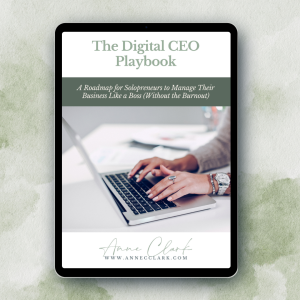
That’s exactly why I created The Digital CEO Playbook.
It’s your roadmap to building a business that runs with structure, intention and flow — so you can stop managing chaos and start leading with clarity.
Inside the playbook, you’ll learn how to:
-
Set up systems that save your time and energy
-
Plan your week like a CEO
-
Refine your offers and pricing
-
Simplify your marketing
-
Use both data and intuition to guide your growth
It’s time to stop doing it all and start doing it right.
by Anne Clark | Jun 17, 2025 | Business, Online Business Manager
There is a story many entrepreneurs tell themselves in the early stages of business.
“I’ll just figure it out myself.”
“It’s faster if I do it.”
“I’ll outsource later, once I’ve grown.”
It seems logical. Resourceful. Even brave. But here’s the truth.
Doing it all yourself might save you money in the short term
It will cost you far more in the long run.
And not just financially.
The Real Cost of DIY Culture
When you’re the strategist, the implementer, the marketer, the tech support, the social media manager and the coach — the business may still be moving, but you’re the engine that never shuts off.
The real cost of DIY shows up as:
-
Decision fatigue that clouds your vision
-
Missed opportunities because you’re stuck in the backend
-
Lack of consistency in your marketing or launches
-
An overwhelmed nervous system that stops you from scaling
You’re in constant motion, but without the structure to support sustainable growth.
You’re not just working hard. You’re working without support — and that changes everything.
What Business Feels Like When You’re Supported
A client recently told me, “It’s the first time I’ve been able to exhale in my business.”
That’s what happens when you stop trying to hold everything together on your own.
When you have someone who gets the vision, knows how to execute, and keeps the business moving while you focus on what you do best — everything changes.
You show up more consistently
You make decisions more clearly
You stop leaking time and energy on things you were never meant to do in the first place
You lead.
What to Ask Yourself Today
If you’ve been running on your own for too long, ask yourself:
-
What tasks take the most from me each week, yet move me the least?
-
How much would my business grow if I had strategic support behind the scenes?
-
Am I building something that could actually scale without me?
Your answers will tell you everything you need to know.
Ready to Step Into a New Chapter?
The truth is, scaling a business doesn’t require you to do more
It requires you to let go of what no longer serves you — including the belief that you have to figure it all out alone.
If you’re ready to be supported by someone who brings structure, strategy and soulful alignment into your business, I’d love to talk.
Because your time is too valuable to spend it doing things that someone else could do better, faster, and with more flow.
by Anne Clark | May 20, 2025 | Business, Digital Marketing, Online Business Manager
If you’re recording long-form video content for YouTube, a web TV show, or your signature series, you’re sitting on a content goldmine. But too many entrepreneurs stop at the upload.
Here’s where I step in.
My specialty is taking that one high-value video and turning it into a powerful, multi-platform content strategy. Without you needing to create anything else from scratch.
This isn’t about doing more—it’s about making what you’ve already created work harder.
Turning One Video into Everything You Need
Here’s how it works:
1. Audio Becomes a Podcast
Once your video is recorded, I extract the audio, clean it up, and add your professional intro and outro. You’ve now got a podcast episode ready to upload to Spotify, Apple Podcasts, and more. It’s a seamless way to expand your reach without any extra effort on your end.
2. Reels and Snippets for Social Media
I scan the video for standout moments and turn them into short, branded reels with captions and headings. These clips are built for impact, tailored to platforms like Instagram, Facebook, LinkedIn and TikTok.
3. Blog Posts From Transcripts
Using the video transcript, I create polished, SEO-optimised blog articles that capture your message and tone. These aren’t robotic rewrites—they’re high-quality pieces that reinforce your expertise and improve your Google ranking.
4. Email Newsletters That Engage
Each video is a story waiting to be told to your list. I distil the key themes into a newsletter article that keeps your subscribers engaged and drives them back to your offers, website or podcast.
5. LinkedIn Articles That Build Authority
For clients looking to grow a presence on LinkedIn, I convert your video insights into a thoughtful, structured article that positions you as a thought leader.
6. Social Posts and Carousels
From your original video, I generate bite-sized takeaways, quotes, and educational posts that translate beautifully into static images, carousel slides, and captions for your broader content plan.
It Doesn’t End There
Three to six months later, I revisit your original content and recreate new versions—tweaked headlines, different visuals, updated angles—so your best material continues to show up without repeating itself. This long-term content recycling strategy keeps your platforms active and relevant.
Why This Works
Your video is packed with value - but without repurposing, most of that value disappears the moment it’s uploaded.
By turning one piece of content into many, we:
-
Save time
-
Maintain consistency across channels
-
Reach your audience wherever they are
-
Maximise the ROI of every video you record
Ready to Make Your Video Content Work Harder?
If you’re investing in video for your YouTube channel or TV show, I can help you transform that single effort into weeks of content across multiple platforms. You stay in your zone of genius—I’ll take care of the rest.
by Anne Clark | May 14, 2025 | Business
A No-Nonsense Guide for Mailchimp Users Who Want to Land in the Inbox — Not the Junk Folder
You spend time crafting the perfect email in Mailchimp, hit send, and then… crickets.
No opens. No clicks. No love.
Before you start questioning your entire life and business, check your spam folder. Chances are, that’s where your masterpiece is hiding.
Here’s why it happens — and how to fix it.
The Top Reasons Your Emails Are Going to Spam
1. Your Subject Line Screams “I’m Spam!”
Too many exclamation marks, all caps, or spammy phrases like “Free!!!” or “Buy now” will trigger filters.
✅ Keep it clean, clever, and curiosity-driven.
2. You’re Using a Dodgy “From” Email Address
If you’re still sending from a Gmail, Hotmail or Yahoo address — stop.
✅ Use a domain-based email (like you@yourbusiness.com) and verify it in Mailchimp under Domains.
3. Your Audience Didn’t Consent (or Forgot They Did)
If your list is full of cold contacts, bought emails, or people who’ve forgotten who you are, you’ll get marked as spam real fast.
✅ Only email people who explicitly opted in, and remind them who you are in your welcome emails.
4. Your Email Content is a Hot Mess
Too many images, not enough text, missing an unsubscribe link, or broken code? That’s a spam filter’s dream buffet.
✅ Keep a balance of images and text, always include your footer with your physical address and unsubscribe link, and test before you send.
5. Poor List Hygiene
Old, disengaged subscribers who haven’t opened your emails in months? They’re dragging down your sender reputation.
✅ Regularly clean your list. Use Mailchimp’s engagement tagging to remove or re-engage cold contacts.
6. You’re on a Shared IP That’s Been Naughty
Mailchimp sends from shared IPs. If another user spams hard, you can be affected.
✅ Maintain a high-quality list and send regularly — Mailchimp gives better sending reputations to active, clean users.
Quick Fixes to Keep You Out of Spam
✅ Authenticate Your Domain (SPF, DKIM, DMARC)
Sounds techy, but Mailchimp walks you through it under Website > Domains. This step tells inboxes: “Yes, I’m legit.”
✅ Use Mailchimp’s Inbox Preview & Spam Checker
Preview your email across devices and check for red flags before hitting send.
✅ Create a Welcome Sequence
Warm up your audience with automation. A friendly intro and some value-driven emails make it less likely they’ll mark you as spam later.
✅ Send Consistently
Ghosting your list for months and then suddenly showing up like “Hey bestie!” is a recipe for spam.
Be consistent. Weekly or fortnightly emails keep your domain warm and trustworthy.
✅ Ask Subscribers to Whitelist You
In your welcome email, teach subscribers how to add you to their address book or drag your email to the Primary tab (hello, Gmail users).
Treat Your Email List Like a VIP Lounge
Don’t invite randoms. Don’t scream at your guests. Don’t disappear for months and show up desperate.
Respect the inbox, and it’ll respect you back.
Bonus Tip:
Want to make sure your emails always get seen?
Use Mailchimp’s “Resend to Non-Openers” feature with a NEW subject line. But don’t overdo it. Once is enough — otherwise, you become the spam.
by Anne Clark | Apr 23, 2025 | Business, How To, LinkedIn
1. Sign Up or Log In
Go to www.linkedin.com.
Click Join now and enter your email address and password.
Follow the prompts to add your first and last name.
2. Add a Professional Profile Photo
Choose a clear, high-resolution headshot.
Smile, dress appropriately for your industry, and make sure your face takes up around 60% of the frame.
No pets, party hats, or sunglasses, unless you’re applying to be a rockstar.
3. Write a Compelling Headline
This appears right under your name and is your mini-billboard.
Don’t just use your job title. Use a value-based headline like:
Helping female-led brands build magnetic digital strategies | Digital Marketer | OBM | Podcast Pro
4. Fill Out the “About” Section
This is your personal elevator pitch. Write in the first person.
Mention:
- What you do
- Who you help
- Your mission or values
- A sprinkle of personality
Example:
I’m a spiritual OBM helping female entrepreneurs ditch the tech overwhelm and show up online with soul-aligned strategy. From email marketing to course launches, I turn chaos into clarity.
5. Add Your Work Experience
List your past and current roles, ideally with descriptions.
Use bullet points to highlight achievements, not just tasks.
Include results where possible (e.g., “Grew client’s list by 5K in 3 months”).
6. Add Skills
Choose key skills that match your niche (LinkedIn allows up to 50).
Prioritise the top 3 that reflect how you want to be known.
7. Ask for Recommendations
Reach out to past clients, managers, or colleagues for testimonials.
A good rec = social proof that sells without you saying a word.
8. Add Education & Certifications
Include schools, courses, certifications, and anything relevant to your career story.
Short courses (Mailchimp Academy, Online Marketing, VA Bootcamp)? Include them!
9. Customise Your URL
Go to “Edit public profile & URL” on the right-hand side.
Change your LinkedIn URL to something clean and easy like:
linkedin.com/in/yourname
10. Turn on “Open to Work” or “Open to Opportunities”
If you’re looking for clients or roles, enable this setting.
You can choose to show it to recruiters only or publicly.
11. Add Featured Content
Highlight your best work: PDFs, links, videos, blogs, testimonials, freebies.
This section is PRIME real estate—use it wisely!
12. Follow Relevant People & Companies
Build your network by connecting with peers, thought leaders, and potential clients.
Leave genuine comments on others’ posts to start showing up as a pro in your space.
13. Start Posting
Share a mix of:
-
Tips and value-based posts
-
Personal stories with lessons
-
Behind-the-scenes of your biz
-
Client wins and results
Tips:
-
Post at least 1-2 times per week to stay visible.
-
Keep your profile updated as your business or job changes.
-
Use a branded banner image at the top of your profile.
by Anne Clark | Apr 22, 2025 | Business
Facebook is Removing Videos from Groups: Here’s How to Save Yours Before They’re Gone
Heard the rumour? Facebook is clearing out videos from Facebook Groups, and if you’ve uploaded content over the years—training videos, lives, memories, or milestone moments—they might disappear. Poof. Gone.
But don’t stress. You don’t need to lose all your valuable content. With a few clicks (and a handy Chrome extension), you can download your videos and keep them safely stored.
Here’s how to save your Facebook Group videos before they vanish into the digital abyss.
Why Is Facebook Removing Group Videos?
Meta (Facebook’s parent company) has been gradually scaling back certain video features in Groups. They’re shifting focus toward Reels, Stories, and monetised video content – which means older video formats in private and public Groups are potentially getting the boot.
Translation? If you don’t download your videos now, you may not be able to access them again.
The Easiest Way to Download Facebook Group Videos (Using Chrome)
To download your videos easily, we recommend using a free Chrome browser extension called “Video Downloader for Facebook”. It’s quick, simple, and doesn’t require a tech degree.
Step-by-Step Guide
✅ Step 1: Use Google Chrome
This only works in Chrome—so if you’re a Safari or Firefox fan, it’s time to switch browsers (just temporarily, promise).
✅ Step 2: Add the Extension
- Head to the Chrome Web Store.
- Search for Video Downloader for Facebook™ by FDown.
- Click “Add to Chrome” and install the extension.
- Once added, you’ll see a little arrow icon in the top right of your browser bar.
✅ Step 3: Go to Your Facebook Group Video
- Navigate to the video you want to save inside your Facebook Group.
- Play the video.
- The arrow icon (the extension) should light up or show a download option.
✅ Step 4: Click to Download
- Click the Video Downloader for Facebook icon.
- Choose the video quality you want (usually “HD” or “SD”).
- Click Download.
- Your video will save directly to your computer.
✅ Step 5: Repeat for Any Other Videos You Want to Save
Rinse and repeat. If you’ve got loads, make a checklist and knock them over with a coffee in hand.
Tip: Organise Your Downloads
Create a folder on your desktop or Google Drive called “Facebook Video Archive” so you can keep everything sorted – especially if you plan to repurpose your content for other platforms (hello Instagram, YouTube, or your next course launch).
For my clients, I have been saving them by their business initials, giving it a number and then the title. eg: ACC 001 – How to Download your Facebook video – it will make it easier for me to set up a directory for them for quick reference.
Don’t Lose Your Content – Future-Proof It
Whether it’s client training sessions, member updates, or your latest “lives with heart” video series—don’t let Facebook’s clean-up sweep away your hard work. Take ten minutes today to download and store your best bits.
Because if not now… when?
Need help turning those videos into valuable evergreen content for your brand? I’ve got you. Let’s chat about how to repurpose, repackage and re-share your brilliance.