
What Is a CRM and Does Your Business Need One?

What Is a CRM and Does Your Business Need One?

I'll admit something.

For years, I thought CRMs were only for big companies with sales teams.

You know the kind of businesses I'm talking about. Hundreds of staff. Dedicated sales managers. Long customer pipelines. Lots of reports and dashboards.

As a small business owner, I honestly thought a CRM would be overkill.

I couldn't have been more wrong.

Looking back, I wish I'd embraced a CRM much earlier because it would have saved me countless hours, helped me stay organised and, most importantly, stopped potential clients from slipping through the cracks.

Today, when I work with a new client, one of the first questions I ask isn't about their website or their social media.

It's much simpler.

"How are you currently keeping track of your enquiries?"

The answers usually sound something like this.

"Mostly my emails."

"I've got a spreadsheet."

"Everything's in my notebook."

"It's all in my head."

If that sounds familiar, you're definitely not alone.

What actually is a CRM?

CRM stands for Customer Relationship Management.

That sounds far more complicated than it really is.

Think of it as the digital home for every conversation you've ever had with a customer or potential customer.

Instead of trying to remember who called last Tuesday, searching through old emails or wondering whether you ever sent that quote, everything lives in one place.

When someone enquires through your website, they become a contact in your CRM.

When you send them an email, it's recorded.

When they book a meeting, it's recorded.

When you make notes after your conversation, they're saved.

The result is a complete history of your relationship with that client.

That might not sound exciting.

Until you lose a lead because you forgot to follow up.

The most expensive sentence in business

Over the years I've heard one sentence more times than I care to remember.

"I thought I'd already replied."

Sometimes they had.

Sometimes they hadn't.

Sometimes the email went to spam.

Sometimes they wrote a draft and never pressed send.

Sometimes they genuinely believed another team member had handled it.

Whatever the reason, the outcome is usually the same.

The potential client moves on to someone else.

Not because your service wasn't good enough.

Because they never heard back.

Those are the kinds of problems a CRM helps solve.

You're already managing relationships

Whether you realise it or not, every business already has a customer relationship management system.

The question is whether it's intentional.

For some businesses, the CRM is a notebook.

For others, it's Outlook folders.

Some rely on memory.

Some use sticky notes.

Some keep everything in spreadsheets.

The problem isn't that these methods never work.

The problem is that they stop working as your business grows.

The more enquiries you receive, the harder it becomes to remember every conversation.

That's usually when opportunities start slipping away.

Imagine this instead

A potential client visits your website.

They download your free guide.

Immediately they're added to your CRM.

They receive a welcome email.

Two days later they're sent another helpful resource.

A week later they receive an invitation to book a discovery call.

When they do, the appointment appears in your calendar automatically.

After the meeting, you move them to the next stage of your sales pipeline.

If they become a client, they're welcomed with an onboarding sequence.

If they don't, they continue receiving valuable emails until they're ready.

Now compare that to manually trying to remember every step.

Which business do you think feels more professional?

A CRM isn't about selling harder

This is one of the biggest misconceptions I hear.

People assume a CRM is designed to help you pressure people into buying.

I don't see it that way at all.

For me, a CRM is about building relationships.

It's about remembering birthdays, following up when you promised you would, knowing what services a client has already purchased and making sure nobody feels forgotten.

That's good customer service.

The technology simply makes it easier to deliver consistently.

The businesses that impress me most

The businesses I admire aren't necessarily the ones with the biggest marketing budgets.

They're the ones that make every customer feel valued.

You enquire and receive an immediate confirmation.

You book an appointment and receive a reminder.

You become a client and receive a thoughtful welcome.

You finish a project and receive a follow-up a few weeks later asking how everything is going.

None of that happens by accident.

It's supported by good systems.

What should a modern CRM do?

When I'm helping a client choose a CRM, I'm looking for far more than a digital address book.

A modern CRM should help you:

  • Capture website enquiries automatically.
  • Track every customer interaction.
  • Manage your sales pipeline.
  • Send automated emails.
  • Book appointments.
  • Store documents and notes.
  • Assign tasks.
  • Trigger workflows.
  • Measure where your leads are coming from.
  • Give you a complete picture of every customer.

If your CRM only stores names and phone numbers, you're barely scratching the surface of what it can do.

Why I recommend Buzzlink

There are some excellent CRM platforms available today.

I've worked with several over the years.

What I like about Buzzlink isn't just the CRM.

It's everything surrounding it.

Your CRM connects naturally with your website.

Your forms.

Your email marketing.

Your calendars.

Your workflows.

Your landing pages.

Your sales funnels.

Instead of buying separate software and hoping it all works together, everything is already designed to communicate.

That means less time managing technology and more time building relationships.

And ultimately, that's what business is all about.

Don't wait until you're overwhelmed

One of the biggest mistakes I see is businesses waiting until they're drowning in enquiries before introducing a CRM.

By then, it's much harder to organise years of customer information.

Starting early means your systems grow alongside your business.

Whether you have ten contacts or ten thousand, you'll know exactly where every conversation stands and what should happen next.

If you've been relying on spreadsheets, notebooks or your memory, this might be the perfect time to explore a better way.

I'd love to show you how Buzzlink's CRM can simplify your customer management and become the foundation of a more organised business.

As a Buzzlink Partner, I can also help you save $500 on your Buzzlink setup when you sign up using my exclusive partner link.

 

Is Your Tech Stack Holding Your Business Back?

Is Your Tech Stack Holding Your Business Back?

I have a confession to make.

A few years ago, I loved new software.

If someone launched a new CRM, I wanted to try it. If there was a new email marketing platform promising higher open rates, I'd sign up for the free trial. A new social media scheduler? Why not? AI tool? Absolutely.

I convinced myself I was staying ahead of the curve.

The reality?

I was creating unnecessary complexity.

Over time I realised something that completely changed the way I work with clients. The businesses that were growing the fastest weren't the ones using the most software. They were the ones using the least amount of software needed to run their business well.

That might sound surprising, especially in a world where there's an app for almost everything, but simplicity is becoming one of the biggest competitive advantages a business can have.

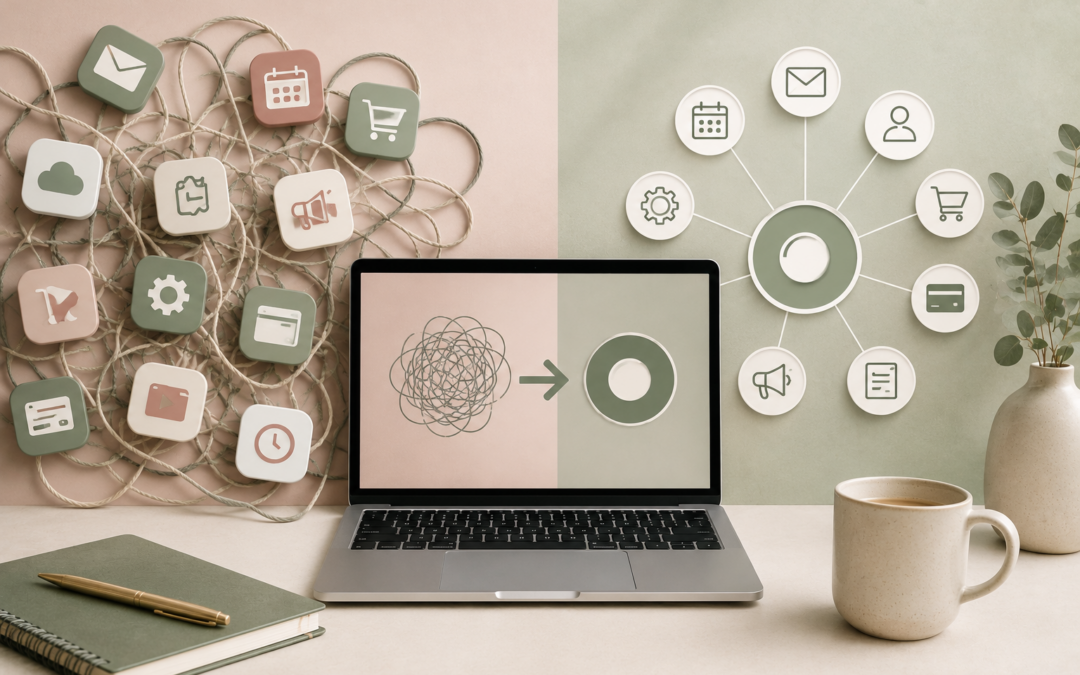
If you've never heard the term tech stack, don't worry. It's simply the collection of software your business uses every day. Your website, CRM, email marketing platform, booking calendar, accounting software, social media scheduler, automation tools and AI assistants all form part of your tech stack.

The question isn't whether you have one.

The question is whether it's helping your business grow or quietly making life harder.

When did running a business become managing software?

One of the questions I ask every new client is surprisingly simple.

"Walk me through your day."

I'm not asking about their marketing strategy or revenue goals. I simply want to know what happens from the moment they sit down at their desk.

The answers are often remarkably similar.

"I check my emails, then I log into my CRM. After that I jump into my booking software, update my social media scheduler, check enquiries from my website, respond to messages, log into my course platform, create an invoice, update my project management software and then finally start working."

Did you notice something?

They've spent the first part of their morning logging into software instead of serving clients.

It happens so gradually that we stop noticing it. Every new tool promises to save us time, but collectively they often have the opposite effect.

The hidden signs your tech stack is working against you

Your software doesn't have to crash for it to be costing you money.

Sometimes the warning signs are much more subtle.

Perhaps you're entering the same customer details into three different systems because they don't communicate properly.

Maybe you're paying for software you haven't opened in months because cancelling it always seems like something you'll do "next week".

You might have a team member who's the only person who understands how your automations work, leaving everyone else nervous about touching anything in case they break it.

Or perhaps you've accepted that things "just take longer" because that's how your business has always operated.

None of those situations feel urgent.

Yet together they slowly chip away at your productivity, profitability and peace of mind.

Complexity creeps in quietly

One of the reasons I find this topic so interesting is that no business owner sets out to create a complicated tech stack.

It happens one decision at a time.

You need online bookings, so you subscribe to a booking platform.

Later you decide to start an email newsletter.

A few months later you launch an online course.

Then you want automated reminders, digital forms, sales funnels, review requests, SMS marketing and customer pipelines.

Each decision makes sense on its own.

It's only when you step back that you realise you've built a business around software instead of software supporting your business.

I've seen businesses with fifteen different subscriptions, all purchased with the best intentions, yet nobody could confidently explain how they all connected.

The real cost isn't what appears on your credit card

Earlier in this series, I talked about software subscriptions and how quickly they add up.

Today I want to look at a different type of cost.

Mental load.

Every piece of software asks something of you.

Remember another password.

Learn another interface.

Read another update.

Watch another tutorial.

Solve another problem.

Individually, none of these tasks seem significant.

Collectively, they're exhausting.

I don't think we talk enough about how much energy technology consumes.

Business owners already wear enough hats. You shouldn't also need to become an IT manager just to keep your business running.

My turning point

There wasn't one dramatic moment that changed my thinking.

It was hundreds of conversations.

Business owners telling me they felt overwhelmed.

Clients paying for software they barely used.

Businesses investing thousands of dollars in websites, only to discover they still needed half a dozen other platforms before they could actually market their business.

Eventually I stopped asking, "What's the best software?"

Instead, I started asking, "What's the simplest way to achieve the outcome?"

That single question has changed almost every recommendation I make.

A simple exercise I'd encourage you to do today

Open your banking app or credit card statement.

Scroll through the last three months and highlight every software subscription.

Don't judge yourself.

Just make a list.

Now write beside each one:

  • What does it actually do?
  • Could another platform already provide this feature?
  • Have I used it in the last month?
  • Is it helping my business grow?

You might discover everything you're paying for is worthwhile.

Or you might find several subscriptions you've completely forgotten about.

Either way, you'll have a much clearer understanding of where your money is going.

It's an exercise I revisit every six months in my own business because software changes quickly, and so do business needs.

Technology should feel invisible

The best business systems don't constantly demand your attention.

They quietly do their job in the background.

Your enquiries arrive where they should.

Your follow-up emails are sent automatically.

Appointments are confirmed.

Tasks are created.

Reviews are requested.

Leads are nurtured.

You don't spend your day thinking about the technology because it's working exactly as it should.

That's what I want every business owner to experience.

Simplicity scales

As businesses grow, many people assume they need more software.

In my experience, they usually need better systems.

Growth brings more customers, more enquiries and more opportunities. If your technology is already fragmented, growth only magnifies those problems.

That's one of the reasons I became a Buzzlink Partner.

I wanted to recommend a platform that helps businesses simplify rather than adding another subscription to the list.

Instead of stitching together separate platforms for websites, CRM, email marketing, automation, calendars, forms, funnels and social media, Buzzlink allows you to manage everything from one connected ecosystem.

It isn't about replacing software for the sake of it.

It's about creating a business that's easier to run, easier to scale and ultimately far less stressful.

Build a business that works for you

When I think about the businesses I most admire, it isn't because they have the latest technology.

It's because they've created systems that support the life they want to live.

They spend more time with clients and less time troubleshooting software.

They make decisions based on strategy instead of reacting to technology problems.

Most importantly, they remember that software is simply a tool.

It should never become the centre of your business.

If reading this article has made you realise your own tech stack has become more complicated than it needs to be, perhaps it's time to simplify.

I'd love to help you review your current systems and explore whether Buzzlink could bring everything together in one place.

As a Buzzlink Partner, I can also help you save $500 on your Buzzlink setup when you sign up using my exclusive partner link.

Why Software Integrations Cost More Than You Think

Why Software Integrations Cost More Than You Think

If you've ever found yourself saying...

"Surely these two programs can talk to each other?"

...you're not alone.

It's one of the most common frustrations I hear from business owners.

On paper, everything looks straightforward.

You have a website.

You have a CRM.

You have an email marketing platform.

You have a booking calendar.

You have accounting software.

Each platform promises to make your business easier.

Then reality sets in.

Your website collects an enquiry... but it doesn't automatically add the person to your CRM.

Your CRM stores the contact... but it doesn't send your welcome email.

Your booking software confirms the appointment... but it doesn't notify your team.

Suddenly you're searching Google for phrases like "How do I connect..." and before you know it, you're paying for another platform whose sole purpose is making your existing platforms communicate.

I've seen this happen so many times that I now call it the integration trap.

What is a software integration?

Let's keep it simple.

A software integration allows two different programs to share information.

For example:

  • Someone fills in a form on your website.
  • Their details are automatically added to your CRM.
  • A welcome email is sent.
  • A task is created for your team.
  • A text message confirms the booking.
  • A follow-up reminder is scheduled.

When everything works together, it's brilliant.

Your customers receive a seamless experience and your business runs far more efficiently.

The problem isn't the idea of integrations.

The problem is how quickly they become complicated.

Every connection creates another dependency

Imagine building a bridge between two islands.

It works perfectly.

Then you build another bridge.

And another.

Soon you've created a network of bridges.

If one bridge closes, traffic is affected everywhere.

Business software works in much the same way.

You connect your website to your CRM.

Your CRM connects to your email marketing.

Your email marketing connects to your webinar software.

Your webinar software connects to your course platform.

Your course platform connects to your payment system.

Now imagine one platform changes an update.

Or an API changes.

Or your subscription expires.

Or someone accidentally disconnects an automation.

Suddenly your carefully designed system stops working.

The frustrating part?

You often don't notice until a customer tells you.

The hidden costs nobody includes in the quote

When someone quotes you for a website, they rarely include the ongoing cost of maintaining integrations.

Yet these costs can be significant.

You might pay for:

  • Integration software
  • Premium automation plans
  • Developer support
  • Ongoing maintenance
  • Troubleshooting
  • Software upgrades
  • Extra user licences

None of those costs are obvious when you're comparing website quotes.

They appear later.

Sometimes months later.

Time spent fixing technology is time you're not serving clients

I always ask clients one question.

"How much is your time worth?"

If you spend two hours every week trying to work out why an automation stopped working, that's over 100 hours every year.

Imagine what you could do with an extra 100 hours.

You could:

  • Meet more clients.
  • Develop a new service.
  • Take a holiday.
  • Spend more time with your family.
  • Focus on marketing.

Instead, you're watching YouTube tutorials trying to reconnect software.

That isn't why you started your business.

Integrations aren't always the answer

Now, don't get me wrong.

I'm not saying integrations are bad.

In fact, they're essential for many larger organisations that rely on specialised software.

But most small businesses don't need dozens of different systems connected together.

They need simplicity.

I've found that many businesses assume they need enterprise-level technology when what they actually need is a platform that already includes the tools they use every day.

That's a very different approach.

A real conversation that stuck with me

Not long ago, I met with a business owner who proudly showed me all the software they were using.

They had spent months researching the "best" platform for every individual task.

The best website.

The best CRM.

The best booking software.

The best email marketing platform.

The best funnel builder.

Individually, every decision made sense.

Collectively, it had become a nightmare.

Nothing worked together properly.

Every new customer required information to be copied between systems.

When something broke, nobody knew where the problem started.

By the end of our conversation they said something I'll never forget.

"I spend more time managing software than I do managing my business."

That's exactly the situation I want to help business owners avoid.

Think about your customer

It's easy to focus on what software means for you.

But what about your customers?

Imagine they:

  • Complete a contact form.
  • Receive no confirmation.
  • Book an appointment.
  • Never receive a reminder.
  • Fill in the same information again.
  • Receive duplicate emails.
  • Get the wrong message.

They don't know an integration failed.

They simply think your business isn't organised.

Every broken automation affects your customer's experience.

My philosophy is simple

I don't believe technology should become another full-time job.

It should quietly work in the background while you focus on serving your clients.

That's why I've become such a strong advocate for simplifying business systems.

Not because simpler is trendy.

Because simpler is sustainable.

When your website, CRM, email marketing, automation, forms, calendars and customer information already live in one platform, there are fewer moving parts.

Fewer moving parts usually mean fewer problems.

Build a business that's easier to run

One of the biggest lessons I've learnt over the years is this.

The businesses that grow consistently aren't always the ones with the most technology.

They're the ones with technology that supports the way they work.

That's one of the reasons I recommend Buzzlink.

Instead of stitching together multiple platforms and hoping they continue communicating, Buzzlink brings your website, CRM, email marketing, workflows, booking calendar, forms, social media scheduling, sales funnels and customer management into one connected system.

It means fewer integrations.

Fewer subscriptions.

Less troubleshooting.

And far more time to focus on growing your business.

Ready to simplify your business?

If you're spending more time managing software than serving your customers, it might be time to rethink your technology.

I'd love to show you how Buzzlink can help you simplify your systems, reduce unnecessary complexity and build a business that works smarter, not harder.

As a Buzzlink Partner, I can help you choose the right setup and save $500 on your Buzzlink setup when you sign up using my exclusive partner link.