by Anne Clark | Feb 1, 2026 | Business, Email Marketing
One of the biggest challenges business owners face when trying to grow their email list is deciding what type of lead magnet to create.
A lead magnet should solve a small but meaningful problem for your ideal client while positioning you as the expert who can help further.
The key is choosing a topic that people are already searching for.
Below are 30 lead magnet ideas designed to attract engaged subscribers.
Why lead magnets grow your business faster
Social media followers can disappear overnight if platforms change their rules.
Your email list is something you own.
Lead magnets help you:
build trust
demonstrate expertise
create connection
generate enquiries
increase sales opportunities
When someone downloads your lead magnet, they are showing interest in your area of expertise.
This makes email marketing one of the most effective long term strategies.
Checklist lead magnet ideas
Website launch checklist
Client onboarding checklist
Social media setup checklist
Email marketing checklist
Brand clarity checklist
Checklists work well because they simplify complex tasks.
Template lead magnet ideas
Welcome email template
Instagram caption templates
Discovery call script
Client proposal template
Sales page outline
Templates save time and remove uncertainty.
Workbook lead magnet ideas
Ideal client workbook
Business clarity workbook
Confidence building workbook
Goal setting workbook
Marketing planning workbook
Workbooks encourage action and engagement.
Guide lead magnet ideas
Beginner guide to email marketing
Beginner guide to online business systems
Beginner guide to content marketing
Beginner guide to creating digital products
Beginner guide to pricing services
Guides provide structured information.
Prompt pack lead magnet ideas
ChatGPT prompts for content ideas
ChatGPT prompts for emails
ChatGPT prompts for social media posts
ChatGPT prompts for lead generation
ChatGPT prompts for service descriptions
Prompt packs are growing in popularity because they save time.
Planner lead magnet ideas
30 day content planner
90 day marketing planner
Weekly business planner
Monthly email schedule
Client attraction planner
Planning tools help reduce overwhelm.
How to validate your idea quickly
Ask your audience what they need
Review common questions in Facebook groups
Look at search trends
Check competitor offers
Test interest through email or social media
Your lead magnet does not need to be complicated.
Simple and useful often converts better.
Want help choosing the best lead magnet idea?
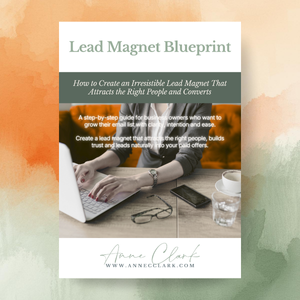
The Lead Magnet Blueprint helps you identify the best topic for your audience and create a resource that builds trust and attracts ideal clients.
Download the Lead Magnet Blueprint and start building your email list today.
by Anne Clark | Jan 14, 2026 | Business
There comes a point in business where availability stops being a virtue.
Early on, we are taught to be flexible, accommodating, grateful for every opportunity. We stretch. We adapt. We make things work. And for a while, that’s part of the growth curve.
But premium leadership asks for something different.
It asks for discernment.
Not everyone is meant to work together. Not because anyone is wrong, but because alignment matters. Energy matters. Trust matters. And when you ignore that, the cost is never just operational. It’s emotional, mental, and energetic.
I’ve learned this the long way.
Discernment Is Not Exclusion. It’s Maturity.
There is a belief that saying no is elitist. That choosing carefully is unkind. That being selective means you are closing doors.
In reality, discernment is leadership.
When you try to work with everyone, you dilute outcomes. You slow momentum. You create friction that no amount of skill can smooth over. You end up managing energy instead of building vision.
At higher levels of business, capability alone is not enough. Alignment is what makes things work.
I don’t work with narcissists or micromanagers. That’s not a dramatic statement. It’s a grounded one. Those dynamics break trust. They create unnecessary complexity. They require constant emotional regulation instead of forward movement.
And I’ve learned to trust that knowing.
Trust Is the Foundation, Not the Reward
The work I do requires trust at the outset.
Not blind trust. Discerned trust.
The kind where someone can hand things over and know they will get sorted. The kind where they do not need to hover, check in constantly, or manage the process. The kind where delegation feels like relief, not risk.
The clients I work best with love that they can brainstorm ideas with me. They love my ideas and intuition. They love that they can focus on business growth and where they need to be, instead of worrying about everything else.
That level of trust does not come from contracts or credentials alone. It comes from alignment.
When alignment is present, work feels calmer. Decisions land faster. Systems take shape without force. Growth feels clean instead of chaotic.
When alignment is missing, even the simplest task feels heavy.
Intuition Belongs in Business
One of the biggest shifts in my own business came when I stopped sidelining intuition and started trusting my guides fully.
Allowing the energy message to come through. Listening to my team of light. Letting that intelligence inform not just ideas, but decisions about people, partnerships, and pace.
This is not separate from strategy. It strengthens it.
Intuition is pattern recognition. It’s foresight. It’s knowing when something will flow and when it will cost too much to maintain. In business, especially at scale, ignoring that information is expensive.
Aligned systems are not rigid. They are responsive. They support the vision instead of constraining it. They create space rather than pressure.
That only happens when the right people are involved.
Why Trying to Be Available to Everyone Backfires
When you stay available to everyone, you end up over-explaining. Over-justifying. Over-managing.
You start second-guessing decisions that were clear at the start. You spend energy proving value instead of creating it. You become the buffer between misaligned expectations and reality.
That is not sustainable leadership.
Strong businesses are built on clear boundaries. Clear roles. Clear energetic agreements.
Choosing who you work with is not about ego. It’s about self-respect. It’s about protecting the quality of the work. It’s about allowing your business to become what it is capable of becoming.
We are not meant to work with everyone.
And when you accept that, everything gets simpler.
Calm Is a Signal
One of the most overlooked indicators of a well-supported business is calm.
Not stagnation. Not complacency. Calm.
The calm that comes from knowing things are handled. From not being in every decision. From trusting the people around you to think, anticipate, and execute without being directed at every turn.
My clients often say they would be lost without my support. Not because they are incapable, but because they are no longer meant to carry everything alone.
They are vision holders. Leaders. Creators.
Their role is to grow the business, not to manage every moving part.
And my role is to hold the structure, the systems, the strategy, and the energetic alignment that allows that growth to happen without chaos.
Leadership Is Saying Yes With Precision
Leadership is not about saying yes to more. It’s about saying yes with precision.
Yes to alignment.
Yes to trust.
Yes to partnerships that feel supportive instead of draining.
And no to what compromises clarity.
The moment you stop trying to be the right fit for everyone is the moment your work deepens. Your results compound. And the right people find you without being invited.
That’s not marketing. That’s resonance.
And that’s leadership.
by Anne Clark | Jan 12, 2026 | Business
Running a business is not just about strategy, systems and sales. Energy plays a bigger role than most people realise. Some days everything flows effortlessly. Other days even the smallest task feels like wading through wet cement.
This is not a personal failing. It is energy.
Planning your business around energy cycles allows you to work with natural rhythms rather than constantly pushing against them. When you align your workload with your energy, productivity improves, stress reduces and decisions become clearer.
What are energy cycles?
Energy cycles refer to predictable patterns of mental, emotional and physical energy. These cycles exist on multiple levels including daily, monthly and seasonal rhythms.
Examples include:
-
Natural highs and lows throughout the day
-
Monthly cycles influenced by the moon
-
Seasonal shifts that affect focus and motivation
Recognising these cycles helps you plan more intelligently rather than relying on willpower alone.
Why traditional planning often fails
Most business planning assumes you operate at a consistent energy level every day. That assumption is flawed.
You are expected to create, market, sell, analyse, communicate and lead at the same intensity all the time. This leads to frustration and self doubt when motivation drops.
Energy-aware planning replaces rigid schedules with responsive structure.
Daily energy cycles
Most people experience higher focus in the morning and lower energy in the afternoon. Creative thinking often peaks earlier in the day, while administrative tasks suit lower energy windows.
Try aligning tasks like:
-
Strategy, writing and decision making with high energy periods
-
Emails, admin and scheduling with lower energy periods
Working this way reduces procrastination and improves output without working longer hours.
Monthly cycles and business planning
Many business owners notice repeating patterns across the month. Some weeks feel expansive and outward focused. Others feel reflective and inward.
Using a monthly rhythm allows you to:
-
Schedule launches or promotions during high visibility phases
-
Plan reviews, reflection and refinement during quieter phases
This creates a sustainable pace rather than constant pressure.
Seasonal energy shifts
Energy naturally changes across the year. Summer often supports visibility, connection and momentum. Winter tends to favour planning, consolidation and rest.
Fighting seasonal energy leads to burnout. Working with it builds longevity.
Consider:
-
Launching or promoting during naturally expansive seasons
-
Creating or refining systems during slower periods
-
Allowing space for rest without guilt
Rest is a business strategy, not a weakness.
Energy cycles and decision making
Decision fatigue increases when energy is low. Important decisions made in depleted states often lead to second guessing.
Energy-aware leaders delay decisions when clarity is low and act decisively when energy supports confidence.
This alone can improve outcomes dramatically.
Practical ways to implement energy-based planning
Start simple. Awareness comes first.
Track your energy levels for two weeks. Note patterns without judgement.
Then:
-
Theme days based on energy rather than tasks
-
Batch similar activities to reduce context switching
-
Plan visibility and sales activities when energy feels expansive
-
Schedule rest and reflection intentionally
Structure creates freedom when it supports your natural rhythm.
The mindset shift required
Planning around energy cycles requires releasing the belief that productivity equals constant output.
Sustainable success comes from aligned action, not relentless effort.
When your business plan honours your energy, work feels lighter, creativity flows more easily and momentum becomes consistent rather than forced.
Your business should support your life, not drain it.
by Anne Clark | Jan 12, 2026 | Business
Email is meant to support your work, not stalk you at all hours like an overly enthusiastic intern. Yet for many business owners, the inbox has become a dumping ground for newsletters, notifications, half read threads, and things you swear were important at the time.
Decluttering your inbox is not about hitting delete and hoping for the best. It is about building a system that keeps the right messages visible and the noise out of your head.
Why inbox clutter happens
Inbox overwhelm usually builds slowly. You sign up for one freebie. You get copied into threads you should never be part of. Clients reply all. Platforms send updates that feel urgent but rarely are.
Soon your inbox becomes a place you avoid rather than manage.
The key problem is not volume. It is lack of structure.
Step one: define what actually matters
Not every email deserves your attention. Start by identifying your high priority emails. These usually fall into a few clear categories:
-
Client or customer communication
-
Financial or legal emails
-
Team or collaborator messages
-
System alerts you genuinely need
Everything else is optional reading.
Once you know what matters, the rest becomes easier to manage.
Step two: use folders and labels properly
Folders are not for hoarding. They are for organising by purpose.
Create folders such as:
-
Clients
-
Finance
-
Projects
-
Receipts
-
Newsletters
-
Read Later
Move emails out of your inbox once they have been actioned or categorised. Your inbox should be a workspace, not an archive.
Step three: set up rules and filters
Filters are the real secret weapon. They quietly do the work for you in the background.
Set rules so that:
-
Newsletters bypass the inbox and go straight to a folder
-
Invoices are labelled and stored automatically
-
Platform notifications skip the inbox entirely
This alone can reduce inbox volume by 50 percent within a week.
Step four: unsubscribe ruthlessly
If you have not opened a newsletter in the last month, unsubscribe. If you feel guilty, unsubscribe anyway. Your inbox is not a community service.
Aim to unsubscribe from at least five emails per week. It adds up quickly.
Step five: schedule inbox time
Constant inbox checking creates anxiety and destroys focus. Treat email like a task, not a reflex.
Choose set times to check your inbox. Morning, midday and late afternoon works well for most business owners.
Outside those times, close it. Nothing explodes. Promise.
Step six: trust your system
The fear of missing something important is what keeps people stuck. A well structured inbox means important emails surface naturally.
If something truly matters, it will reach you again.
Your inbox should feel calm, not chaotic. Decluttering is not about perfection. It is about control.
by Anne Clark | Jan 9, 2026 | Business
If there is one thing that will quietly derail a business relationship faster than a missed invoice or a dodgy Wi-Fi connection, it is poor communication. Not the dramatic, door-slamming kind. The polite nodding while silently fuming kind. The “it’s fine” when it is absolutely not fine kind.
Clear, honest communication is the backbone of any successful business relationship. Without it, expectations drift, resentment builds, and suddenly everyone is confused about why things feel off but no one is saying it out loud.
Say it early. Say it clearly. Say it kindly.
When something is not going the way you expected, the worst move is silence. Silence does not keep the peace. It slowly poisons it.
If something feels misaligned, say so. That does not mean pointing fingers or firing off an emotional message at 10:47pm. It means clearly outlining:
This gives the other person something concrete to respond to. Mind reading is not a business skill.
Honesty beats politeness every time
Many people avoid honest conversations because they do not want to upset the other person. Ironically, that avoidance usually causes far more damage than a respectful, direct conversation ever would.
Lying by omission, sugar-coating feedback, or pretending everything is fine creates a false reality. The other person is making decisions based on information that is incomplete or inaccurate. That is not fair on them, and it is not fair on you.
You can be honest without being harsh. In fact, clarity is a form of respect.
Own your side of the communication breakdown
Here is the uncomfortable but powerful truth. Sometimes the issue is not that the other person is not listening. It is that you were not as clear as you thought you were.
This happens more often than people like to admit.
You might assume something was obvious. You might have explained it once while multitasking. You might have changed direction without clearly stating that the goalposts had moved.
Strong communication includes the willingness to say, “I realise I may not have communicated that clearly.” That sentence alone can dissolve defensiveness and reopen productive dialogue.
Set expectations, not assumptions
Many business frustrations come down to unspoken expectations. Timelines, response times, scope, priorities, decision-making authority. If it lives only in your head, it does not count as an agreement.
Clear communication means setting expectations early and revisiting them often. It also means checking in rather than checking out when something feels off.
A simple conversation now beats a messy fallout later.
Feedback is not failure
Feedback is information. It is not a personal attack, a rejection, or a sign that someone is bad at their job. When handled well, feedback strengthens relationships and improves outcomes.
The strongest business relationships are not the ones without friction. They are the ones where friction is addressed openly, respectfully, and before it turns into resentment.
Communication builds trust, silence erodes it
Trust is built when people feel safe to speak honestly and know they will be met with professionalism rather than defensiveness. Silence, avoidance, and vague communication do the opposite.
If you want better results, better relationships, and fewer awkward moments pretending everything is fine, communicate sooner, clearer and with a willingness to own your part.
It is not about being perfect. It is about being real, responsible, and willing to have the conversation.
Business works better when people do.
by Anne Clark | Jan 9, 2026 | Business, Email Marketing
If you have ever wondered how some businesses seem to effortlessly grow their email list while others struggle to get subscribers, the answer often comes down to one key asset: a strong lead magnet.
A lead magnet is a valuable free resource offered in exchange for someone’s email address. When created strategically, a lead magnet attracts people who are genuinely interested in what you offer and are more likely to become paying clients.
The problem is most lead magnets are created quickly without understanding what actually motivates someone to subscribe.
The good news is creating a high converting lead magnet does not need to be complicated when you follow a proven structure.
What is a lead magnet?
A lead magnet is a free piece of content designed to solve a specific problem for your ideal client.
Examples include:
checklists
templates
guides
workbooks
video training
resource lists
planners
The purpose is to provide immediate value while positioning you as the expert who can help further.
When someone downloads your lead magnet, they are raising their hand and saying they want support in that area.
This makes your email list one of the most valuable assets in your business.
Why most lead magnets fail
Many business owners create a lead magnet based on what they want to talk about rather than what their audience is actively searching for.
Common mistakes include:
being too broad
covering too many topics
providing information without a clear outcome
creating something too complex
choosing topics that are not urgent problems
A strong lead magnet focuses on one clear transformation.
For example:
instead of creating a guide called “Everything you need to know about marketing”
create something specific like:
30 content ideas for service businesses
pricing calculator for freelancers
client onboarding checklist
Specific problems convert better because people immediately understand the value.
The 5 types of high converting lead magnets
Some formats consistently perform well because they are quick to consume and easy to implement.
Checklist
People love simple steps they can follow quickly.
Templates
Templates remove the guesswork and save time.
Workbooks
Interactive resources help people take action immediately.
Guides
Step by step instructions provide clarity and confidence.
Prompt packs
Perfect for saving time and generating ideas quickly.
Choosing the right format depends on the problem you are solving.
If your audience feels overwhelmed, a checklist works well.
If they feel stuck, prompts or templates can help.
If they feel confused, a guide provides clarity.
How to choose the right lead magnet topic
The best lead magnet topics sit at the intersection of:
what your audience wants
what you can help with
what leads naturally to your paid offer
Ask yourself:
What questions do clients ask repeatedly?
What problem do people want solved quickly?
What first step would help someone move forward?
What would make someone trust your expertise?
Your lead magnet should feel like a quick win.
When people experience value quickly, they are more likely to purchase from you.
How to structure your lead magnet for fast results
A simple structure works best.
Introduction
Explain the outcome they will achieve.
Main content
Provide clear steps or resources.
Action section
Encourage implementation.
Next step
Introduce how you can help further.
Keep the design clean and easy to read.
Avoid overwhelming people with too much information.
Clarity converts better than complexity.
Common mistakes to avoid
Trying to impress rather than help
Including too much theory
Not providing practical steps
Weak titles that do not highlight the benefit
Creating something your audience does not urgently need
The goal is not to create something long.
The goal is to create something useful.
Simple steps to launch your lead magnet quickly
Choose one specific problem
Select a simple format
Create the content
Design a simple download page
Connect to your email system
Share consistently
Your first lead magnet does not need to be perfect.
It just needs to be helpful.
Ready to create your own lead magnet?
If you want a step by step structure that takes the guesswork out of creating a high converting freebie, the Lead Magnet Blueprint walks you through exactly what to create and how to connect it to your email marketing system.
Download the Lead Magnet Blueprint and start growing your email list with clarity and confidence.
by Anne Clark | Jan 8, 2026 | Business
Video content has become one of the most powerful tools for businesses wanting to show up online. From social media reels to website introduction videos, video helps brands connect with their audience faster than almost any other format.
But creating video content regularly can also be time-consuming.
That is why tools like FlexClip continue to evolve. The platform has recently introduced two new AI-powered features that make video creation even easier: AI Create and Auto Edit.
For marketers, business owners, and content creators, these tools are designed to turn ideas or raw clips into polished videos in minutes.
What Are FlexClip’s New AI Video Features?
FlexClip’s new tools focus on simplifying the video creation process by using artificial intelligence to handle much of the heavy lifting.
The two key updates include:
Both tools are designed to help users produce professional videos faster, even if they have little or no editing experience.
You can explore these new features here:
https://www.flexclip.com/ai-video-magic
AI Create: Turn an Idea Into a Video in Minutes
One of the most impressive new additions is AI Create.
Instead of starting with a blank timeline, you simply describe the video you want to create. The AI then generates a complete video structure for you.
This can include:
-
Video clips
-
Scene layouts
-
Text overlays
-
Music suggestions
-
Transitions
Essentially, the AI builds the foundation of your video automatically.
For business owners who struggle with where to start, this feature removes the biggest barrier to creating video content.
You can simply enter a prompt such as:
“Create a promotional video for a wellness coach”
or
“Create a social media video introducing my consulting services.”
Within moments, FlexClip generates a video draft you can customise.
For marketers managing multiple accounts, this dramatically speeds up content production.
Auto Edit: Turn Raw Clips Into a Polished Video
The second new feature, Auto Edit, is equally useful.
Instead of manually editing clips, you upload your raw footage and FlexClip automatically turns it into a finished video.
The AI can:
This is particularly useful for people who have video footage but do not want to spend hours editing.
For example, if you have recorded:
Auto Edit can quickly assemble them into a professional-looking video.
For social media managers, this feature is a huge time saver.
Why These AI Tools Matter for Business Owners
Many business owners know they should be creating video content but feel overwhelmed by the editing process.
AI tools like these are changing that.
With FlexClip’s AI features, you can now:
-
Create videos faster
-
Reduce editing time
-
Generate ideas when you feel stuck
-
Turn raw clips into usable content
-
Maintain consistent content output
This means more businesses can start using video without needing professional editing skills.
Ideal Uses for FlexClip’s AI Video Tools
These new features are particularly useful for creating:
Instead of spending hours building a video from scratch, you can generate a starting point in minutes and customise it to suit your brand.
Why Tools Like This Are Changing Content Creation
AI video tools are transforming the way businesses create content.
What once required expensive editing software and technical skills can now be done through simple online tools.
FlexClip’s AI Create and Auto Edit features are designed to make video production more accessible, especially for small business owners, marketers, and content creators who need to produce regular content.
For me, tools like this are incredibly helpful when creating reels for clients or building quick promotional videos for websites.
They remove much of the friction that traditionally slowed down video production.
Making Video Marketing Simpler
If you are creating video content for your business or clients, FlexClip’s new AI features are definitely worth exploring.
AI Create helps generate ideas and structure videos quickly, while Auto Edit transforms raw footage into polished content without the usual editing time.
Together, these tools make video marketing simpler, faster, and far more accessible.
And when video becomes easier to produce, businesses are far more likely to show up consistently online, which is exactly what good marketing requires.
by Anne Clark | Jan 4, 2026 | Business
Choosing an email platform feels simple until your inbox hits 10,000 unread messages and your stress levels follow.
Gmail, Outlook and Apple Mail all promise organisation, productivity and ease. The reality depends on how you work and what you actually need.
Here is a clear breakdown without the tech jargon headache.
Gmail: the system lover’s favourite
Gmail remains the most popular choice for business owners for a reason. It is powerful, flexible and integrates beautifully with other tools.
Pros:
-
Excellent filtering and labelling
-
Strong spam protection
-
Seamless integration with Google Drive, Calendar and Docs
-
Easy access across devices
Cons:
-
Can feel overwhelming if left unmanaged
-
Labels confuse people used to folders
-
Requires setup to truly shine
Best suited for business owners who love automation, integrations and working in the cloud.
Outlook: the corporate classic
Outlook is still a strong contender, especially for those working with larger teams or corporate clients.
Pros:
-
Strong calendar and task integration
-
Familiar interface for corporate environments
-
Excellent for structured workflows
Cons:
Outlook works well for business owners managing teams, shared inboxes or corporate style operations.
Apple Mail: simple and streamlined
Apple Mail is clean, minimal and quietly efficient. It does not try to do everything, which is both its strength and limitation.
Pros:
-
Simple interface
-
Great for Apple users
-
Low learning curve
Cons:
Apple Mail suits solopreneurs who value simplicity over complexity and live entirely in the Apple ecosystem.
Which one should you choose in 2026?
There is no universal best option. The best platform supports your workflow, not someone else’s.
Choose Gmail if you want flexibility and automation. Choose Outlook if you run a team or work closely with corporate systems. Choose Apple Mail if you want a calm, no fuss experience.
The platform matters less than how you use it. A messy inbox on any system is still a messy inbox.
by Anne Clark | Dec 18, 2025 | Business
Summer holidays do something magical to our brains. The inbox goes quiet, the calendar loosens its grip, and suddenly we can think again. Big thoughts. Brave thoughts. The kind of thinking that usually gets drowned out by meetings, notifications, and “just one more thing.”
That is why summer is prime time for business reading. Not the dense, nap-inducing kind. The good stuff. Books that stretch your perspective, challenge how you lead, sharpen how you grow, and quietly plant ideas that come back swinging in the new year. The right book read at the right time can change how you run your business, how you see success, or how you show up altogether.
This curated list brings together 25 business books that are genuinely trending right now. These are the titles business owners, leaders, and creatives are actually talking about, highlighting, and recommending, not dusty classics collecting shelf guilt. Grab one for the beach, one for the plane, or one for a slow morning with coffee. Your future self will thank you.
Still everywhere for a reason. Raw leadership, mindset, money, health, and growth lessons without corporate fluff. Grab your copy here
A powerful read for leaders who want influence without losing their integrity. Get the book here
Perfect for anyone playing the long-term success game and tired of quick wins that burn out fast. Read it here
If you work with people rather than over them, this book will sharpen your influence instantly. Buy your copy here
A brilliant read for leaders and business owners who want to challenge their own thinking, stay adaptable, and avoid getting stuck in outdated beliefs. This book is all about the power of rethinking, unlearning, and staying mentally flexible in a fast-changing world. Get the book here
Straight-talking, practical and unapologetically direct. If you want more leads, start here. Get the book here
A brilliant reminder that bigger is not always better in business. Read more here
If your business makes sales but your bank account says otherwise, this one is non-negotiable. Grab your copy here
Still trending because people keep building businesses that run them instead of the other way around. Buy it here
A masterclass in creating unforgettable experiences that keep customers coming back. Get the book here
Small changes, massive impact. This book earns its hype. Read it here
Productivity that actually feels good. No burnout badge required. Find your copy here
Perfect for business owners doing the inner work alongside the outer growth. Buy it here
A powerful reframe on growth, learning, and what really drives success. Get the book here
A must-read if time always feels like it is slipping through your fingers. Grab your copy here
Ideal for anyone drowning in ideas, notes, and digital clutter. Read it here
Short, practical, and perfect for anyone building visibility or a personal brand. Get the book here
If branding matters to your business, this one will change how you see colour and design. Buy your copy here
Personal branding without the awkward self-promotion. Find it here
Because great storytelling is one of the most underrated business skills. Read more here
A short, practical read that will immediately improve how you lead conversations. Get the book here
Still a standout for leaders who value courage, clarity, and connection. Grab your copy here
A thought-provoking read for anyone reimagining leadership, culture, and work itself. Buy it here
Unexpectedly brilliant for improving focus, flow, and how you work day to day. Find your copy here
If doing less but better sounds like your 2026 goal, start here. Read it here
Summer reading tip from your CEO sidekick
Do not try to read all 25. Pick 3 to stretch your thinking, 1 to calm your nervous system, and 1 purely because it feels fun. Business growth loves rest, reflection, and a good book by the pool.
by Anne Clark | Dec 16, 2025 | Boundaries, Business, Spiritual Entrepreneurs, Spirituality
It only takes one.
One client.
One colleague.
One conversation.
Suddenly you are replaying emails in your head, second-guessing your experience, questioning decisions you were confident about yesterday, and wondering if maybe you are not as capable as you thought.
This usually does not happen because you lack skill, integrity, or professionalism.
It happens because someone expected everything for nothing.
Why This Situation Happens So Often
People who expect more than what was agreed, without respect for boundaries, often operate from entitlement rather than alignment.
This can show up as:
-
Constantly pushing scope
-
Ignoring agreed processes
-
Undermining decisions
-
Dismissing your expertise
-
Expecting instant access, instant fixes, or emotional labour
-
Making subtle comments that erode confidence
These behaviours are rarely about your competence.
They are about control, insecurity, or a lack of understanding of the value of what you bring.
Why It Hits So Deeply
When someone questions your abilities unfairly, it can feel deeply personal. Especially if you are conscientious, heart-led, or someone who genuinely cares about doing good work.
It can make you feel:
Over time, this chips away at confidence and disconnects you from your natural rhythm and intuition.
The danger is not the person.
The danger is believing their narrative.
The Subtle Trap People Fall Into
When faced with this behaviour, many capable people respond by:
-
Giving more for free
-
Over-delivering to prove worth
-
Explaining instead of standing firm
-
Taking responsibility for someone else’s dissatisfaction
This does not fix the problem.
It reinforces it.
People who expect everything for nothing rarely become satisfied. They simply move the goalposts.
What Is Actually Being Triggered
Often, this situation activates old conditioning.
You might have learned early that:
-
Keeping the peace was safer
-
Being liked mattered more than being respected
-
Saying no felt uncomfortable
-
Proving yourself was how you stayed secure
That is why one person can destabilise you more than ten supportive ones.
This is not weakness.
It is awareness asking to evolve.
How to Protect Yourself Without Hardening
Protecting yourself does not mean closing your heart or becoming cold.
It means anchoring into clarity.
Here are grounded strategies that work both practically and energetically.
Return to facts, not feelings
When doubt creeps in, come back to what is real. Your experience, your agreements, your results. Write them down if needed.
Re-establish boundaries calmly and clearly
Boundaries are not punishments. They are information. Clear communication protects both parties.
Stop absorbing emotional responsibility
Someone else’s frustration does not mean you have failed. Their expectations are theirs to manage.
Notice energy leaks early
If you feel dread, tightness, or heaviness before interactions, pay attention. The body knows before the mind catches up.
Anchor into your values
Ask yourself, am I acting from fear or from alignment? Adjust from there.
Protecting Your Energy Is Not Optional
Energy protection is not spiritual fluff. It is nervous system care.
This can look like:
-
Creating clear start and stop times
-
Not responding immediately out of obligation
-
Grounding yourself before difficult conversations
-
Releasing the need to be understood by everyone
-
Detaching your worth from outcomes you do not control
You do not need to convince someone of your value if they are committed to misunderstanding it.
Keep Showing Up as Your True Self
One difficult person does not get to rewrite your story.
Do not let misaligned expectations dim your confidence.
Do not let entitlement override your self-trust.
Do not abandon yourself to keep someone else comfortable.
Your true form is not louder, harder, or more defensive.
It is steadier.
Clearer.
More self-led.
And the more you stand in that energy, the less power these situations have over you.
The Quiet Reminder
People who respect you do not ask you to shrink.
They do not drain you.
They do not confuse you.
If one person makes you question everything while others feel supported and uplifted by your presence, the data is clear.
Trust yourself.
Protect your energy.
Keep showing up as you.
That is how you stay aligned.
That is how you keep moving forward.
And that is how your work continues to matter.