Signs Your Business Has Outgrown Do It Yourself Marketing

Signs Your Business Has Outgrown Do It Yourself Marketing

DIY marketing is not a mistake. For many business owners, it is the only way to begin. You learn by doing, experimenting, and figuring things out as you go. You write your own posts, build your own website, send your own emails, and manage your own platforms.

In the early stages, this is empowering.

But there comes a point where DIY marketing stops feeling resourceful and starts feeling heavy. The signs are subtle at first. Then one day, you realise that marketing has become the thing you avoid the most, even though you know how important it is.

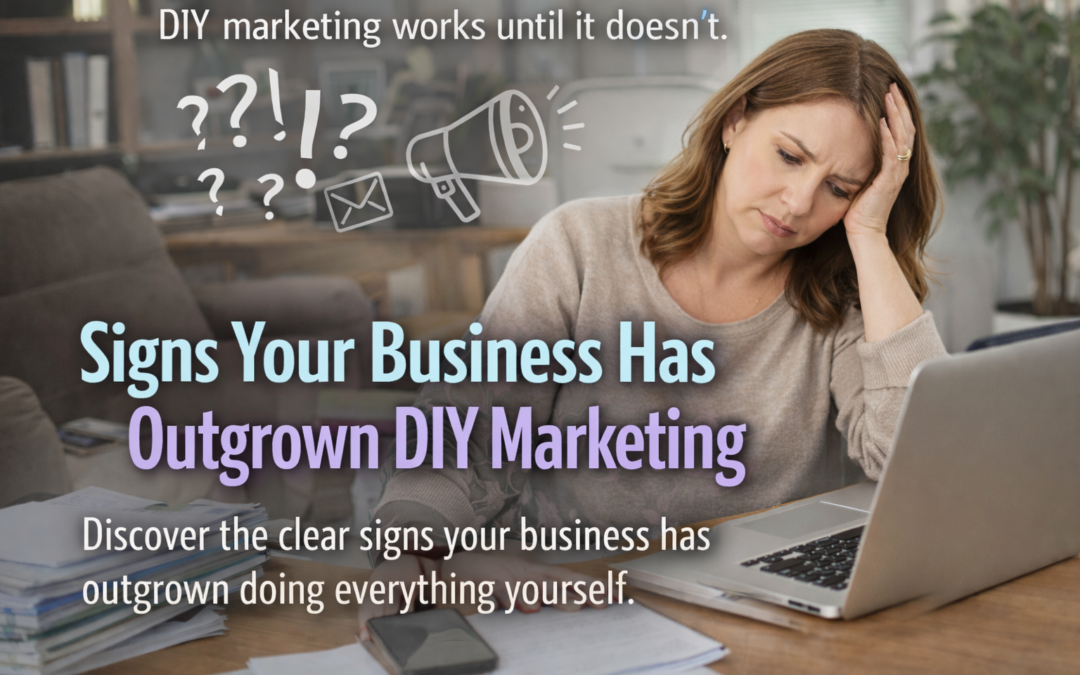
DIY marketing works until it doesn’t.

If your business has reached this stage, it does not mean you have failed. It means you are growing.

You are always behind, no matter how hard you try

One of the clearest signs your business has outgrown DIY marketing is the constant feeling of being behind. Content is rushed or skipped. Emails are sent inconsistently or not at all. Launches feel last minute and reactive.

You might have good intentions, but marketing keeps falling to the bottom of the list because client work, admin, and life come first.

This is not a discipline issue. It is a capacity issue.

Marketing requires planning, preparation, and follow-through. When your business grows, trying to squeeze it into leftover time no longer works.

You know what to do, but execution feels messy

At this stage, most business owners are not beginners anymore. You understand the basics. You know consistency matters. You know you should be emailing your list, repurposing content, and tracking results.

But execution feels clunky.

You jump between tools. You second-guess your strategy. You start and stop initiatives without finishing them. Nothing feels cohesive.

This often happens because marketing has become more complex than one person can manage well on their own. The issue is not knowledge. It is structure.

Marketing drains your energy instead of building momentum

There is a difference between something feeling challenging and something feeling draining. When marketing consistently drains your energy, it is a sign you are working outside your zone of genius.

Many service-based business owners are brilliant at what they do, but not energised by the mechanics of marketing. Planning content, scheduling posts, managing platforms, setting up emails, and maintaining systems can feel like a constant mental load.

Over time, this leads to avoidance and frustration.

Sustainable businesses are built when founders focus on the work only they can do, and support is brought in for the rest.

Your growth has plateaued

DIY marketing often leads to a growth ceiling. Not because it is ineffective, but because it relies on spare time and spare energy.

As your client load increases, the time available for marketing decreases. Visibility becomes inconsistent. Leads slow down. Growth plateaus.

This is often the moment business owners assume something is wrong with their offer, pricing, or message. In reality, the issue is that marketing no longer has the support it needs to scale.

Growth requires systems. Not just effort.

You feel scattered instead of strategic

Another sign your business has outgrown DIY marketing is feeling scattered. You try different platforms. You test new ideas. You start things but struggle to maintain them.

Without a clear structure, marketing becomes reactive instead of intentional.

You may find yourself asking questions like:

  • What should I focus on right now?

  • Am I doing the right things?

  • Why does this feel harder than it should?

These questions are signals that your business needs strategic support, not more content ideas.

You want support, but fear losing control

Many business owners reach this stage and hesitate. They know they need help, but they worry about losing their voice, values, or integrity.

This fear is valid. Marketing is personal, especially for service-based and personal brands.

The key difference is not whether you outsource, but how. The right support works with your voice, not over it. It helps you show up more consistently as yourself.

Letting go of control does not mean disconnecting. It means creating space.

DIY marketing served you, but it is not meant to be permanent

DIY marketing is a phase, not a failure. It teaches you what matters. It helps you understand your audience. It builds resilience and awareness.

But businesses that grow sustainably do not rely on DIY forever.

They evolve. They build systems. They bring in aligned support.

This is not about doing less. It is about doing what matters most.

What support actually looks like at this stage

Outgrowing DIY marketing does not mean handing everything over overnight. It often starts with:

  • Clarifying your strategy

  • Simplifying your platforms

  • Creating repeatable systems

  • Delegating execution while retaining direction

Support should feel grounding, not overwhelming. Structured, not chaotic.

If DIY marketing is starting to feel heavy, scattered, or unsustainable, it may be time to explore a different way.

👉 Explore my marketing and OBM services and discover how aligned support can help your business grow with clarity and ease.


Not Everyone Is Meant to Work Together. And That’s Leadership.

Not Everyone Is Meant to Work Together. And That’s Leadership.

There comes a point in business where availability stops being a virtue.

Early on, we are taught to be flexible, accommodating, grateful for every opportunity. We stretch. We adapt. We make things work. And for a while, that’s part of the growth curve.

But premium leadership asks for something different.

It asks for discernment.

Not everyone is meant to work together. Not because anyone is wrong, but because alignment matters. Energy matters. Trust matters. And when you ignore that, the cost is never just operational. It’s emotional, mental, and energetic.

I’ve learned this the long way.

Discernment Is Not Exclusion. It’s Maturity.

There is a belief that saying no is elitist. That choosing carefully is unkind. That being selective means you are closing doors.

In reality, discernment is leadership.

When you try to work with everyone, you dilute outcomes. You slow momentum. You create friction that no amount of skill can smooth over. You end up managing energy instead of building vision.

At higher levels of business, capability alone is not enough. Alignment is what makes things work.

I don’t work with narcissists or micromanagers. That’s not a dramatic statement. It’s a grounded one. Those dynamics break trust. They create unnecessary complexity. They require constant emotional regulation instead of forward movement.

And I’ve learned to trust that knowing.

Trust Is the Foundation, Not the Reward

The work I do requires trust at the outset.

Not blind trust. Discerned trust.

The kind where someone can hand things over and know they will get sorted. The kind where they do not need to hover, check in constantly, or manage the process. The kind where delegation feels like relief, not risk.

The clients I work best with love that they can brainstorm ideas with me. They love my ideas and intuition. They love that they can focus on business growth and where they need to be, instead of worrying about everything else.

That level of trust does not come from contracts or credentials alone. It comes from alignment.

When alignment is present, work feels calmer. Decisions land faster. Systems take shape without force. Growth feels clean instead of chaotic.

When alignment is missing, even the simplest task feels heavy.

Intuition Belongs in Business

One of the biggest shifts in my own business came when I stopped sidelining intuition and started trusting my guides fully.

Allowing the energy message to come through. Listening to my team of light. Letting that intelligence inform not just ideas, but decisions about people, partnerships, and pace.

This is not separate from strategy. It strengthens it.

Intuition is pattern recognition. It’s foresight. It’s knowing when something will flow and when it will cost too much to maintain. In business, especially at scale, ignoring that information is expensive.

Aligned systems are not rigid. They are responsive. They support the vision instead of constraining it. They create space rather than pressure.

That only happens when the right people are involved.

Why Trying to Be Available to Everyone Backfires

When you stay available to everyone, you end up over-explaining. Over-justifying. Over-managing.

You start second-guessing decisions that were clear at the start. You spend energy proving value instead of creating it. You become the buffer between misaligned expectations and reality.

That is not sustainable leadership.

Strong businesses are built on clear boundaries. Clear roles. Clear energetic agreements.

Choosing who you work with is not about ego. It’s about self-respect. It’s about protecting the quality of the work. It’s about allowing your business to become what it is capable of becoming.

We are not meant to work with everyone.

And when you accept that, everything gets simpler.

Calm Is a Signal

One of the most overlooked indicators of a well-supported business is calm.

Not stagnation. Not complacency. Calm.

The calm that comes from knowing things are handled. From not being in every decision. From trusting the people around you to think, anticipate, and execute without being directed at every turn.

My clients often say they would be lost without my support. Not because they are incapable, but because they are no longer meant to carry everything alone.

They are vision holders. Leaders. Creators.

Their role is to grow the business, not to manage every moving part.

And my role is to hold the structure, the systems, the strategy, and the energetic alignment that allows that growth to happen without chaos.

Leadership Is Saying Yes With Precision

Leadership is not about saying yes to more. It’s about saying yes with precision.

Yes to alignment.
Yes to trust.
Yes to partnerships that feel supportive instead of draining.

And no to what compromises clarity.

The moment you stop trying to be the right fit for everyone is the moment your work deepens. Your results compound. And the right people find you without being invited.

That’s not marketing. That’s resonance.

And that’s leadership.

Best Business Books to Read Over the Summer Holidays

Best Business Books to Read Over the Summer Holidays

Summer holidays do something magical to our brains. The inbox goes quiet, the calendar loosens its grip, and suddenly we can think again. Big thoughts. Brave thoughts. The kind of thinking that usually gets drowned out by meetings, notifications, and “just one more thing.”

That is why summer is prime time for business reading. Not the dense, nap-inducing kind. The good stuff. Books that stretch your perspective, challenge how you lead, sharpen how you grow, and quietly plant ideas that come back swinging in the new year. The right book read at the right time can change how you run your business, how you see success, or how you show up altogether.

This curated list brings together 25 business books that are genuinely trending right now. These are the titles business owners, leaders, and creatives are actually talking about, highlighting, and recommending, not dusty classics collecting shelf guilt. Grab one for the beach, one for the plane, or one for a slow morning with coffee. Your future self will thank you.

The Diary of a CEO – Steven Bartlett

Still everywhere for a reason. Raw leadership, mindset, money, health, and growth lessons without corporate fluff. Grab your copy here

Good Power – Ginni Rometty

A powerful read for leaders who want influence without losing their integrity. Get the book here

The Long Game – Dorie Clark

Perfect for anyone playing the long-term success game and tired of quick wins that burn out fast. Read it here

Leading Without Authority – Keith Ferrazzi

If you work with people rather than over them, this book will sharpen your influence instantly. Buy your copy here

Think Again – Adam Grant

A brilliant read for leaders and business owners who want to challenge their own thinking, stay adaptable, and avoid getting stuck in outdated beliefs. This book is all about the power of rethinking, unlearning, and staying mentally flexible in a fast-changing world. Get the book here

$100M Leads – Alex Hormozi

Straight-talking, practical and unapologetically direct. If you want more leads, start here. Get the book here

Company of One – Paul Jarvis

A brilliant reminder that bigger is not always better in business. Read more here

Profit First – Mike Michalowicz

If your business makes sales but your bank account says otherwise, this one is non-negotiable. Grab your copy here

The E-Myth Revisited – Michael E. Gerber

Still trending because people keep building businesses that run them instead of the other way around.  Buy it here

Unreasonable Hospitality – Will Guidara

A masterclass in creating unforgettable experiences that keep customers coming back. Get the book here

Atomic Habits – James Clear

Small changes, massive impact. This book earns its hype.  Read it here

Feel-Good Productivity – Ali Abdaal

Productivity that actually feels good. No burnout badge required. Find your copy here

The Mountain Is You – Brianna Wiest

Perfect for business owners doing the inner work alongside the outer growth.  Buy it here

Hidden Potential – Adam Grant

A powerful reframe on growth, learning, and what really drives success. Get the book here

Four Thousand Weeks – Oliver Burkeman

A must-read if time always feels like it is slipping through your fingers. Grab your copy here

Build a Second Brain – Tiago Forte

Ideal for anyone drowning in ideas, notes, and digital clutter.   Read it here

Show Your Work – Austin Kleon

Short, practical, and perfect for anyone building visibility or a personal brand. Get the book here

Brand Brilliance – Fiona Humberstone

If branding matters to your business, this one will change how you see colour and design. Buy your copy here

You Are the Brand – Mike Kim

Personal branding without the awkward self-promotion. Find it here

Storyworthy – Matthew Dicks

Because great storytelling is one of the most underrated business skills. Read more here

The Coaching Habit – Michael Bungay Stanier

A short, practical read that will immediately improve how you lead conversations. Get the book here

Dare to Lead – Brené Brown

Still a standout for leaders who value courage, clarity, and connection. Grab your copy here

Reinventing Organizations – Frederic Laloux

A thought-provoking read for anyone reimagining leadership, culture, and work itself. Buy it here

Work Clean – Dan Charnas

Unexpectedly brilliant for improving focus, flow, and how you work day to day. Find your copy here

Essentialism – Greg McKeown

If doing less but better sounds like your 2026 goal, start here.   Read it here

Summer reading tip from your CEO sidekick

Do not try to read all 25. Pick 3 to stretch your thinking, 1 to calm your nervous system, and 1 purely because it feels fun. Business growth loves rest, reflection, and a good book by the pool.

You Can’t Grow Your Business Without a Strategy or End Goal

You Can’t Grow Your Business Without a Strategy or End Goal

Too often I hear business owners say, “I want to grow my business” and then… silence. No clarity, no action plan, no roadmap. Wanting growth is one thing, but without a defined strategy or end goal, you are just wishing, not building.

So, let’s start with the obvious questions:

  1. How do you want to grow it? Is it through more sales of digital products, more coaching clients, or more service offerings?
  2. What funnels do you have in place to lead people to take those actions?
  3. How are you showing up so that people can actually find you?

We are not living in the movie Field of Dreams. You can’t just build it and expect them to come. Your job is to showcase, educate, and guide your audience toward the outcome you want them to take. Assuming people just “get” what you want them to do only leads to one thing: disappointment.

Think of Your Business Like a Street Map

Picture your business as a map. You know the destination you want to reach, but there are many routes to get there. You need to create and support those different pathways so that your customers can safely arrive where you want them to go.

For example:

  • A coach says they want more clients but only posts randomly on Instagram. Without a funnel, the posts lead nowhere, so bookings stay flat.
  • A digital product creator spends weeks building a gorgeous sales page, but never runs ads, creates emails, or shares it with their audience. No one buys because no one knows it exists.

Both had destinations, but no clear routes to get there.

This is a Customer Journey

Your customer journey is not a straight line. You need to ask:

  • Where are they coming from?
  • What pain point or problem are you solving?
  • How will you show them you are the expert they need in their life?

Once they arrive, what happens next? Do they continue with you? Do they step away and return later? What points of the journey keep them connected to you?

The more clearly you can picture their journey, the more you can design and nurture those touchpoints. This is what keeps people supported and talking about you to others.

Start Mapping Today

Here are three steps to get you moving right now:

  1. Define your growth goal — Do you want more clients, more digital product sales, or more visibility?
  2. Map your funnel — What lead magnets, offers, or pathways exist to guide people to your goal?
  3. Show up consistently — Choose how and where you will educate, guide, and attract the right people.

Growth Comes From Relationships

Remember, your focus should not always be on chasing new customers. Your existing clients are your biggest asset. I have built much of my business through referrals because I always aim to go above and beyond. People remember that.

Sometimes the journey does not unfold the way we desire, and that is okay. Every experience is an opportunity to refine the path and make sure it works for you, not against you, moving forward.

The truth is simple. You cannot grow your business if you don’t have a strategy or an end goal. Define the path, nurture the journey, and show up as the guide your customers need.

FREE Customer Journey Mapping

👉 Download a copy of my new ebook & workbook on Customer Journey Mapping to help you visualise, design, and refine your own business roadmap. It will walk you through how to map your customer’s journey from start to finish so you can grow with clarity and purpose.

Why I Chose to Let a Client Go (and Why It Was the Best Decision for My Business)

Why I Chose to Let a Client Go (and Why It Was the Best Decision for My Business)

Letting go of a client is never easy, especially when you pour your heart into your work and take pride in delivering to a high standard. But sometimes, the hardest decisions are the most necessary ones.

This wasn’t a decision I made lightly. In fact, I fought with both my head and my heart over it. I wanted to finish the project. I wanted to honour my commitment. I wanted to maintain my professional integrity. But I also couldn’t ignore how their energy was beginning to compromise mine.

Their constant pressure and lack of space for creativity started creeping into every part of my process. Instead of collaborating, they hovered. Instead of trusting, they micro-managed. And instead of flowing, I found myself second-guessing every step, doubting my capabilities, and even, uncharacteristically, making mistakes.

That’s not me. I’ve built my business over the past 14 years by being the calm, confident one behind the scenes. The one who delivers, creates, and supports with integrity and clarity.

And yet, I was shrinking.

Looking back, the signs were there early. I saw them. I felt them. But I talked myself out of them because this client came through a referral from someone I truly admire. So I ignored the red flags, and that’s on me.

Working with them felt less like a professional partnership and more like being stuck in a chaotic dating scenario where one person is so desperate to make it work, they bulldoze everything in their path. They threw every possible idea at me with no real strategy. They wouldn’t take my advice, even though I’ve been doing this a long time. Their words didn’t match their actions. And instead of co-creating, they had me doing everything—messaging, content, strategy, you name it. That’s not what I was hired for, and I’m not an expert in their field. I’m an expert in mine.

Still, I showed up. I delivered. I researched. I stretched myself. I gave them my best.

And yet, it wasn’t enough for them.

The turning point? I woke up one morning and didn’t want to start work on my own business.

That was the moment I knew something had to change.

Because I love what I do. I’ve worked long, hard hours over the past 14 years, but I’ve never resented it. I’m fuelled by passion, purpose, and the amazing people I get to support. But this one client was dimming that light, and worse, they were affecting how I showed up for the clients I do love working with.

So I chose me. I chose my energy. I chose my business.

I let them go.

And here’s what I’ve learned (or rather, relearned): Your energy is your most valuable business asset. You can’t do your best work in an environment that doesn’t feel safe, aligned, or respectful. And no amount of money, referral, or obligation is worth sacrificing your peace for.

If you’re a service provider reading this and you’re stuck in a client relationship that makes you feel small, compromised, or creatively blocked, this is your permission slip.

You can be professional and still protect your peace. You can be committed and still draw a line. You can love what you do and still choose to walk away.

And most importantly, you can always choose you.