
Every Leading Lady Needs a Brilliant Co-Star in Business

Every Leading Lady Needs a Brilliant Co-Star in Business

Why successful women in business need more than another person to delegate tasks to.

I'll be the Thelma to your Louise. The Cagney to your Lacey. The Grace to your Frankie. The Monica to your Rachel. Or even the Laverne to your Shirley.

And if we're having one of those weeks, I'll happily be the Samantha to your Carrie. Although I draw the line at spending half the working day discussing shoes. We've got a business to run!

Think about some of the most iconic female partnerships we've watched over the years. What made them so memorable wasn't that they were exactly alike. Quite often, they were complete opposites.

One was organised while the other was spontaneous. One was practical while the other had a head full of wild ideas. One liked following the rules while the other was already halfway out the door doing something questionable.

But they had something important in common. They had each other's backs.

And that got me thinking about women in business.

Why do so many incredibly capable businesswomen feel they have to do absolutely everything themselves?

The Reality of Being a Successful Woman in Business

Most women don't start a business because they dream of spending their evenings fixing website problems, creating email automations or figuring out why their social media scheduler has suddenly stopped working.

They start because they're passionate about something. They have expertise to share, people to help, ideas to explore and a vision of what they want their business to become.

Then the business starts growing.

Suddenly, they're not just the business owner. They're the marketing manager, customer service department, social media creator, website administrator, email marketing specialist, IT support person and chief problem solver.

Oh, and somewhere in between all of that, they still need to deliver the actual service their customers are paying for.

Sound familiar?

I've worked alongside business owners for years and one of the biggest challenges I see isn't a lack of ideas, ambition or ability. It's that too much of the business depends on one person.

And quite often, that person is very good at doing everything.

Which, ironically, becomes part of the problem.

Because when you know how to do something, it's incredibly easy to convince yourself that you might as well keep doing it.

Before long, you're spending more time running the machinery of your business than doing the work you actually love.

You Don't Need to Do Everything Yourself to Be Successful

Somewhere along the way, many business owners develop the belief that being successful means being able to handle everything.

We celebrate independence, determination and the ability to make things happen. And rightly so.

But there's a difference between being capable of doing something and it being the best use of your time.

Just because you can create your own social media graphics doesn't mean you should spend every Sunday afternoon doing it.

Just because you understand how your email marketing platform works doesn't mean you need to personally build every automation.

And just because you've always managed every part of your business doesn't mean you need to continue doing so as your business grows.

The next stage of business growth often requires a different way of working, not simply working harder.

This is where having the right support can make an enormous difference.

Not just someone to take tasks off your list, but someone who understands your business, recognises opportunities and helps you move towards the bigger picture.

Every Thelma Needs a Louise, But Let's Avoid the Cliff!

Now, before anyone gets concerned, I'm certainly not suggesting we drive your business off a cliff.

Quite the opposite.

I'd like to think I'm the person who notices the cliff, checks the GPS and suggests a better route before we get anywhere near it!

What I love about these iconic female partnerships is that neither woman needs to be everything.

Think about Grace and Frankie. Two very different women with different personalities, strengths and ways of approaching life. Yet together, they discover opportunities and possibilities they might never have explored independently.

Or Cagney and Lacey. Two strong women who brought different skills and perspectives to the table while working towards a common goal.

That's how I see a great business partnership.

You don't necessarily need someone who thinks exactly like you. You need someone whose experience, skills and perspective complement your own.

Someone who can look at your business with fresh eyes, ask questions you haven't considered and help you recognise opportunities that are difficult to see when you're immersed in the everyday running of things.

And occasionally, someone who will gently remind you that starting another new project might not be the best idea when you've already got six unfinished ones.

We've all been there!

What's the Difference Between a Virtual Assistant and an Online Business Manager?

This is a question worth exploring because not all business support is the same.

A Virtual Assistant (VA) typically helps with specific tasks such as administration, scheduling, inbox management, customer support or content uploads. A great VA can be an incredibly valuable part of your business.

An Online Business Manager (OBM) generally takes a broader view, helping coordinate business operations, projects, systems, processes and the people involved in keeping everything running.

Rather than simply asking, "What would you like me to do today?", an OBM is more likely to be thinking about what needs to happen next, what's slowing the business down and how different activities connect to your overall goals.

My own work combines Online Business Management, digital marketing and strategic business support.

That means I'm not just looking at whether your social media posts are scheduled. I'm considering whether your content is attracting the right people and encouraging them to take the next step.

I'm not just checking whether your email newsletter has been sent. I'm looking at how your email marketing supports your customer journey, builds relationships and creates opportunities for your business.

And I'm not just interested in whether your systems are working today. I want to know whether they're going to support your business as it continues to grow.

Because all those little pieces need to work together.

Ready to Stop Doing Everything Yourself?

You didn't build your business to spend your days managing every task, fixing every problem and chasing every unfinished project.

If you're ready for someone who understands the bigger picture, takes initiative and helps turn your ideas into action, I'd love to work alongside you.

As your Online Business Manager and Digital Marketing partner, I can help you streamline your systems, strengthen your marketing, coordinate projects and create a business that doesn't rely on you doing absolutely everything.

Let's talk about where your business is now, where you want it to go and how I can help you get there.

What Does Having a Strategic Business Partner Actually Look Like?

Imagine having someone in your business who understands what you're working towards and can help connect the dots between your ideas, marketing and operations.

You mention that you'd love to launch a new programme in a few months. Instead of that idea sitting on your never-ending to-do list, we start exploring what needs to happen to bring it to life.

We consider the customer journey, the website content, the marketing strategy, the email sequences, the booking process and the systems required to support it.

Or perhaps you're getting plenty of website traffic but not enough enquiries.

Rather than immediately suggesting you post more on social media, we look at what's actually happening. Is your website communicating your value clearly? Are visitors being encouraged to take action? Is there a disconnect between your marketing and your offers?

Maybe you've got several platforms that don't communicate with each other, which means you're manually completing tasks that could be automated.

We look at how to simplify those processes so your business becomes easier to manage.

Sometimes the solution is a new strategy. Sometimes it's improving what you already have. And sometimes it's recognising that you don't need another tool, another platform or another complicated process.

You just need the existing pieces to work properly.

Good business support isn't about making you busier. It's about helping your business operate more effectively.

The Best Business Partnerships Are Built on Trust

One of the things I've learnt over 15 years of running my own business is that the strongest working relationships aren't necessarily the ones where everyone agrees all the time.

They're the ones where people can have honest conversations.

When someone is genuinely invested in your business, they should be comfortable enough to question an idea, suggest an alternative or point out something you might have overlooked.

That doesn't mean taking over your business or making decisions for you.

You're still the business owner. It's your vision, your expertise and your direction.

But it does mean having someone who can contribute ideas, offer a different perspective and help you make informed decisions.

Sometimes I'll be the person saying, "That's a fantastic idea. Let's work out how to make it happen."

Other times, I might be the one asking, "Before we jump into this, how does it fit with everything else we're working towards?"

And occasionally, I'll be the one reminding you that we probably don't need to sign up for another software platform just because someone on LinkedIn said it was amazing.

A little bit of common sense can save a surprising amount of money!

Your Customers Don't Even Need to Know I Exist

Here's something that might sound a little unusual.

I'm perfectly happy being the person behind the scenes.

In fact, your customers might have absolutely no idea I exist.

They see your professional social media content, receive your newsletters, download your resources, visit your website and experience a business that feels organised and connected.

What they don't necessarily see is the planning, strategy, systems, marketing and coordination happening in the background.

And that's exactly how it should be.

My role isn't to become the face of your business. It's to help you show up as the face of yours.

I love seeing business owners step confidently into their expertise, knowing that the important things behind the scenes are being looked after.

Whether that's managing digital marketing activities, improving SEO and online visibility, creating email marketing campaigns, supporting a launch or helping coordinate business operations, my focus is always on making sure the work supports your bigger goals.

Because when the right things are happening behind the scenes, you have more time and headspace to focus on the parts of your business that genuinely need you.

How Do You Know When It's Time for More Business Support?

There's no magic revenue figure or perfect stage of business growth that tells you it's time to bring someone into your corner.

But there are usually some fairly obvious signs.

You might find yourself constantly working in your business with very little time to work on its future. You've got wonderful ideas but struggle to find the time to implement them. Your marketing happens inconsistently because client work always takes priority.

Perhaps you're paying for several systems but aren't using them effectively, or you're spending hours on repetitive tasks that could be simplified.

You might even be turning down opportunities because you simply don't have the capacity to take on anything else.

And sometimes the biggest sign is much simpler.

You're tired of having to think about absolutely everything.

You'd love to have someone you can talk ideas through with, someone who understands how the different parts of your business connect and someone you can trust to take initiative.

Not because you can't do it yourself.

But because you've reached the point where doing everything yourself is no longer helping you move forward.

You Can Be the Leading Lady Without Playing Every Role

There's something incredibly powerful about women supporting other women in business.

Not competing. Not comparing. Not trying to prove who can work the longest hours or juggle the most responsibilities.

Just recognising that we all bring different strengths to the table and that working together can create opportunities we might struggle to achieve alone.

You can be independent without being isolated.

You can be ambitious without being permanently overwhelmed.

And you can build a successful business without personally managing every single detail.

Imagine what you could do with the time you currently spend troubleshooting technology, creating content, managing processes and chasing unfinished tasks.

What ideas could you finally bring to life? What opportunities could you explore? How much more attention could you give to your clients, your expertise and the direction of your business?

That's what the right business partnership should help create.

Not simply a shorter to-do list, but a business that works better.

Looking for Your Business Co-Star? Let's Work Together

If you've made it this far, perhaps you've recognised a little of yourself in this article.

Maybe you're the woman with a head full of ideas, a successful business and a to-do list that seems to have developed a life of its own.

Maybe you're ready to stop being the person who has to remember, manage, organise and implement absolutely everything.

Or perhaps you'd simply love to have someone in your corner who understands business, marketing and systems and can help you see the bigger picture.

That's where I come in.

I'm Anne C Clark, an Online Business Manager and Digital Marketer who works alongside business owners to bring their ideas to life, simplify their operations and strengthen their marketing.

I bring experience, strategy, practical support and a healthy dose of intuition to the businesses I work with.

You bring your vision, your expertise and those wonderfully ambitious ideas.

Together, we work out how to make them happen.

I'll happily be the Thelma to your Louise, the Cagney to your Lacey or the Grace to your Frankie.

And unlike Thelma and Louise, we're definitely planning a much better ending!

You don't need another person waiting for instructions. You need someone who can see the bigger picture, take ownership and help move your business forward.

If you're ready to stop juggling everything and start working with someone who genuinely has your back, let's have a conversation.

We'll talk about your business, what's working, what's holding you back and where the right support could make the biggest difference.

Your next chapter in business doesn't have to be a solo performance.
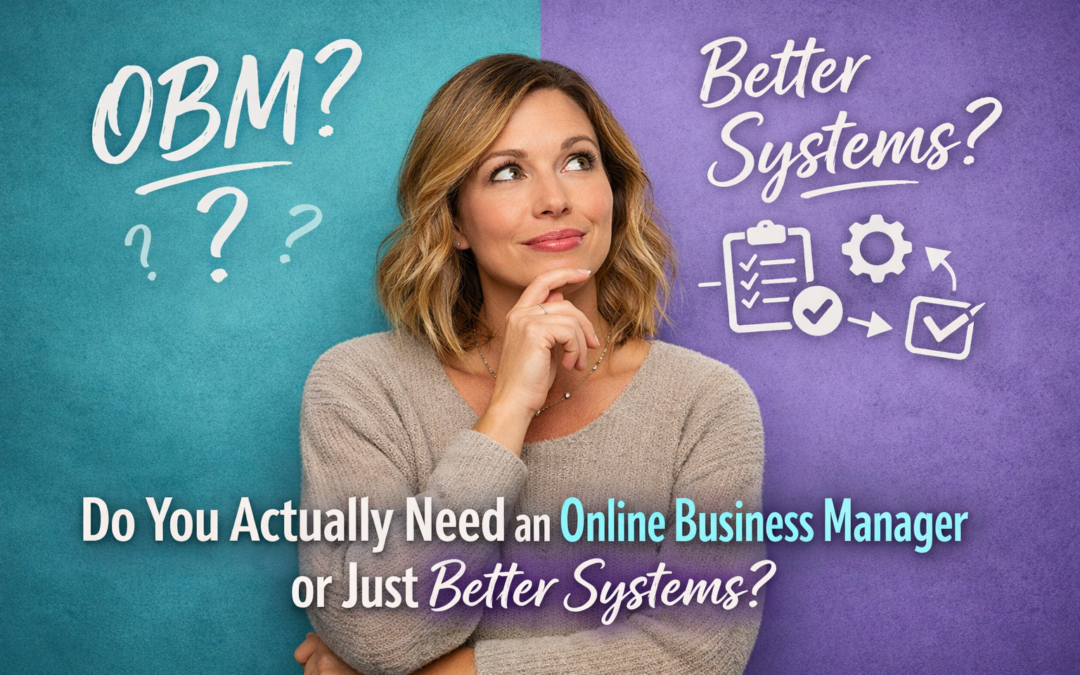
Do You Actually Need an OBM or Just Better Systems?

Do You Actually Need an OBM or Just Better Systems?

At some point in business, effort stops being the problem. You are showing up, creating content, responding to clients, launching offers, and trying to stay consistent. Yet things still feel messy. Progress feels slower than it should. You start wondering if you need help or if you just need to get more organised.

This is usually the moment people start searching for an Online Business Manager.

But here is the honest truth. Not every business needs an OBM yet. Some need better systems. Others need both.

Let’s work out where you actually sit.

What an Online Business Manager really does

An Online Business Manager is not a VA with a fancier title. An OBM looks at your business as a whole and focuses on structure, flow, systems, and sustainability.

This includes:

  • Business operations and workflows

  • Marketing systems and content planning

  • Project management and launches

  • Team coordination

  • Technology and tools

  • Strategy alignment

The goal is simple. Your business should run smoothly without everything relying on you.

Signs you might only need better systems

You may not need an OBM yet if:

  • You are still the only person in your business

  • You do not have consistent offers or income streams

  • You are unclear on what you want to grow

  • You do not yet have repeatable processes

  • You feel scattered but not overwhelmed by volume

In this case, systems work and clarity usually come first.

Signs you are ready for an OBM

You are likely ready for an Online Business Manager if:

  • Your business is generating consistent income

  • You have multiple offers, platforms, or projects running

  • You are managing contractors or thinking about it

  • You feel like you are the bottleneck

  • You know what you want to grow but not how to hold it all

This is the stage where better systems alone are no longer enough. You need someone who can see the whole picture and help you implement it.

The cost of waiting too long

Many business owners wait until they are exhausted before bringing in support. By then, systems are messy, content is inconsistent, and momentum has slowed.

An OBM is not about rescue. It is about sustainable growth.

The intuitive piece most people ignore

This is where intuitive strategy matters. When your business systems are misaligned with how you actually work, no amount of structure will feel good.

Your energy, capacity, season of life, and strengths matter. A good OBM works with that, not against it.

If you are unsure whether you need systems, strategy, or full OBM support, start with clarity. Book a clarity call and let’s work out what will actually move your business forward.

Why Your Website Isn’t Getting Leads

Why Your Website Isn’t Getting Leads

Have you ever looked at your website analytics and thought, "People are visiting my website, so why isn't anyone contacting me?"

It's one of the most common conversations I have with business owners.

Many people believe that once a website goes live, the enquiries will naturally start flowing in. Unfortunately, that's rarely the case. A website isn't a magic solution. It's one piece of a much bigger marketing system, and if that system isn't working together, your website can quickly become an expensive online brochure.

Over the years, I've worked with businesses that have spent anywhere from a few thousand dollars to well over $10,000 on a website. Some looked incredible. Others were packed with features. Yet many of them had one thing in common.

They weren't generating leads.

The good news is that it's usually fixable.

Your visitors don't know what to do next

When someone lands on your website, they should immediately know the next step.

Do you want them to:

  • Book a discovery call?
  • Request a quote?
  • Download a guide?
  • Purchase a product?
  • Join your mailing list?

If your call to action isn't obvious, visitors often leave without taking any action at all.

I always encourage my clients to look at every page through the eyes of a first-time visitor. If it isn't immediately clear what happens next, it's time to simplify.

You're relying on a contact form

This surprises a lot of business owners.

Most websites only offer a contact form, assuming visitors are ready to enquire straight away.

In reality, most people aren't ready to buy the first time they visit your website.

They might be researching.

They might be comparing businesses.

They might simply be curious.

If they leave without giving you their details, you've lost the opportunity to continue the conversation.

That's why I encourage businesses to offer something valuable in exchange for an email address. It could be a checklist, guide, template or resource that genuinely helps your ideal client.

Once they're on your email list, you can continue building trust long after they've left your website.

Your website isn't connected to your marketing

This is one of the biggest problems I see.

Businesses often have:

  • A website.
  • A separate CRM.
  • An email marketing platform.
  • A booking calendar.
  • Social media scheduling software.
  • Online forms.
  • Automation software.

Each platform has its own login, subscription and learning curve.

Even worse, many don't communicate properly with one another.

Instead of creating a seamless experience for customers, business owners spend their time trying to make technology work together.

Your website should be the centre of your marketing, not another disconnected tool.

You're not following up quickly enough

Research consistently shows that responding to a new enquiry quickly increases your chances of converting that lead.

Yet many businesses still rely on manually checking emails throughout the day.

Imagine someone submits an enquiry at 9.30 pm.

Do they receive an acknowledgement?

Do they receive useful information while they wait?

Do you get notified immediately?

Or does that enquiry sit untouched until the next morning?

Automation allows your business to continue working, even when you've switched off for the day.

You're measuring the wrong numbers

I often hear business owners proudly tell me their website had thousands of visitors last month.

Traffic is only one piece of the puzzle.

I'd much rather see a website with 300 visitors and 30 genuine enquiries than one with 3,000 visitors and only two leads.

The numbers I focus on include:

  • Enquiries received
  • Conversion rate
  • Phone calls
  • Booked appointments
  • Email subscribers
  • Sales generated

Those are the numbers that actually grow a business.

Your website was built and forgotten

A website shouldn't be something you launch and never touch again.

Google rewards websites that stay active and continue providing useful information.

That's one of the reasons I'm such a strong believer in blogging.

Every article you publish answers another question your ideal client is already searching for.

Over time, those articles build trust, improve your search rankings and position you as the expert in your industry.

One helpful blog today could still be bringing enquiries to your business three years from now.

Your website should be working just as hard as you are

When I sit down with a client, I don't just look at their website.

I look at the entire customer journey.

How does someone find you?

What happens after they visit your website?

How are enquiries managed?

Are they nurtured through email marketing?

Do they receive reminders?

Are follow-ups automated?

Can you see exactly where every lead came from?

When those pieces work together, your website becomes much more than a digital brochure.

It becomes one of the hardest-working members of your team.

That's exactly why I recommend an all-in-one platform like Buzzlink. Rather than paying for multiple subscriptions that don't always communicate with each other, you can manage your website, CRM, email marketing, automation, calendars, forms, social media scheduling and so much more in one place.

It saves time, reduces complexity and helps you focus on what you do best, running your business.

If you're wondering whether your current website is really working for you, I'd be happy to have a conversation.

You might discover that the problem isn't your website at all. It might simply be the systems behind it.

Ready to simplify your business?

If you're tired of juggling multiple software subscriptions and want a smarter way to manage your website, marketing and customer relationships, I'd love to show you what's possible with Buzzlink.

Sign up using my exclusive partner link and receive $500 off your Buzzlink setup.

You Don’t Need Another Offer You Won’t Finish – You Need a Plan

You Don’t Need Another Offer You Won’t Finish – You Need a Plan

If you’re anything like most purpose-driven business owners, you don’t have a shortage of ideas.
You have notebooks full of them
Sticky notes on the wall
Voice notes on your phone
Late-night bursts of creativity that feel like downloads from something bigger

But here’s the thing.

Ideas are easy.
Execution is what moves the needle.

And no matter how inspired an offer is, if you don’t have a plan to bring it to life, it becomes just another brilliant idea gathering dust.

The Idea Loop That Keeps Entrepreneurs Stuck

I see this constantly.

A client has a huge vision. They’re lit up by the potential. They map out a course, a membership, a launch or a funnel in a moment of inspiration — then hit a wall.

Life gets busy
Tech becomes overwhelming
The energy dips
The idea gets shelved

Three months later, they’re inspired again. But the same cycle repeats.

It’s not that they aren’t capable. It’s that they’re trying to do too much alone — and without structure, even the most aligned offer can become a source of frustration.

What Changes When You Have a Plan (and a Partner)

When you have the right support, things move differently.

You go from:

  • Wondering what to prioritise to having a mapped-out plan

  • Spinning your wheels in tech to launching with confidence

  • Sitting on offers for months to selling with structure and soul

I’ve walked beside clients who had a dozen half-finished projects
Together, we brought them to life — one clear, strategic, aligned step at a time

And the shift wasn’t just in output
It was in energy
In clarity
In ownership

Ask Yourself This Before You Start Something New

  • Am I clear on how this offer fits into my bigger business model?

  • Do I know the exact steps needed to bring it to life?

  • Who is helping me move from vision to completion?

If you don’t have those answers, you don’t need another offer.
You need a plan.
And possibly a partner to walk beside you through it.

Ready to Turn Your Ideas Into Income?

I help business owners who are overflowing with ideas but under-supported in execution.
We map your vision.
We build the steps.
We move it into the world — sustainably and strategically.

Because you weren’t meant to hold it all alone
And your best ideas deserve to be seen, not just scribbled in a notebook

If that’s where you’re at, I’d love to connect.

What High-Level Clients Actually Look For When Hiring Support

What High-Level Clients Actually Look For When Hiring Support

When clients are ready to scale their business, they aren’t looking for someone to just “help out.”

They’re looking for someone they can trust with their vision
Someone who thinks ahead
Someone who can lead, manage and execute — without needing constant direction

They’re not hiring for tasks.
They’re hiring for outcomes.

And the difference between being hired as support versus being seen as a trusted partner comes down to more than skillset.

It comes down to presence, ownership and energy.

High-Level Clients Want More Than a To-Do List Ticker

Let’s get clear on what premium clients are actually looking for when they hire someone to work alongside them in their business:

  • Proactive Communication – They don’t want to chase updates. They want someone who anticipates needs and keeps things moving.

  • Strategic Thinking – They value input. They want someone who can refine ideas, not just implement them.

  • Trust and Discretion – They need to feel safe handing over access, ideas and responsibility.

  • Energy Alignment – They want to feel like you get them. Not just in process, but in presence.

When someone is hiring at a high level, it’s never just about what you do — it’s about how you show up.

From Task-Doer to Trusted Partner

I’ve worked with clients who have said the same thing over and over again:

“I just need someone I don’t have to manage.”
That’s not a small ask — but it is the standard when someone is ready to invest at a premium level.

It means you walk in with clarity
You make decisions when they can’t
You hold the thread of their business when they are in client mode, parenting mode or resting mode

That’s what builds long-term relationships.
That’s what makes you irreplaceable.

If You’re Ready to Attract High-Level Clients, Ask Yourself:

  • Am I showing up as a leader in the spaces I want to be hired?

  • Do I take initiative in every part of my client experience?

  • Can I confidently support the backend and the big picture?

Premium clients are not just buying your time.
They are buying certainty.

Want to Be That Person for Your Clients?

If you’re building a business that delivers more than checklists
If you want to stand beside your clients as a true partner
Or if you are that client and need someone to step into your business with that level of care and skill — let’s connect

Because the people who are ready to go to the next level are looking for someone who already operates from that level
Not someone they need to train up to get there

And if that’s you, I’m ready when you are.

How to Grow Your Business Online Without Wasting Time

How to Grow Your Business Online Without Wasting Time

Digital Marketing Strategies That Actually Work: How to Grow Your Business Online Without Wasting Time

Let’s be real — digital marketing can feel like a giant jigsaw puzzle with too many pieces. One minute you’re hearing about algorithms and the next, someone’s telling you to post three Reels a day and become besties with your email list.

Overwhelming? Absolutely.
Doable? Totally — once you know what matters.

Digital marketing is no longer a “nice-to-have” — it’s the beating heart of how modern businesses connect, convert and grow. Whether you’re brand new or just ready to level up, this guide will walk you through the essentials in a clear, no-fluff way.

Let’s dive into digital marketing that actually drives results (without driving you crazy).

Why Digital Marketing Is a Big Deal

Everyone (and we mean everyone) is online. Your dream customers are scrolling, searching, tapping and double-tapping their way through content every day — and they’re looking for brands and businesses that get them.

That’s where digital marketing shines. It helps you:

  • Show up in the right place at the right time

  • Build genuine relationships

  • Track what’s working so you can tweak as you grow

  • Reach more people without breaking the bank

And unlike old-school marketing, you can actually see what’s working in real time. From traffic and clicks to sign-ups and sales — it’s all measurable.

Meet the Digital Marketing Dream Team

Here’s a breakdown of the main players in your marketing toolkit — and why they matter.

✨ SEO (Search Engine Optimisation)

Get found on Google by the people who are already searching for what you offer. It’s all about using the right keywords, writing great content and making sure your website plays nice with search engines.

Content Marketing

This is your chance to shine. Blog posts, videos, podcasts, freebies — content lets you educate, inspire and connect with your audience without being salesy.

Social Media

Whether you love Reels, lives or just want to post once a week — social media helps you build a community, show your personality and grow brand awareness.

Email Marketing

Your email list is pure gold. It’s the one space where you own the audience and get to show up directly in someone’s inbox. Use it wisely and it will love you back.

PPC (Pay-Per-Click)

If you do want to dip your toes into paid advertising, PPC lets you run highly targeted ads on search engines or social platforms. Great for a traffic boost when used strategically.

Set SMART Goals (Not Just Vague Intentions)

Before you jump into posting, planning or creating, pause and get clear. Your digital marketing will only work if it’s anchored in solid goals.

Think SMART:

  • Specific: “Grow my Instagram by 500 followers” not “get more followers”

  • Measurable: Use data to track progress

  • Achievable: Keep it realistic for your time, skills and budget

  • Relevant: Tie goals back to your bigger business mission

  • Time-bound: Give yourself deadlines (and maybe a reward when you hit them)

Building a Digital Strategy That Doesn’t Suck

Here’s your roadmap to creating a strategy that’s intentional, creative and effective.

1. Know Your People

Who are you talking to? What are they struggling with? What lights them up? Create a clear picture (aka buyer persona) and write for that person — not everyone on the internet.

2. Do Keyword Research

Find out what your ideal client is searching for. Use tools like Ubersuggest or Google’s Keyword Planner to find terms you can use in your blogs, site and content.

3. Create Value-Driven Content

Whether it’s an email, an Instagram post or a video — every piece of content should serve a purpose:

  • Solve a problem

  • Share a story

  • Inspire action

  • Build connection

4. Use Social Media Intentionally

You don’t need to be everywhere. Pick 1–2 platforms you enjoy and show up consistently with value, personality and purpose. Plan ahead with a content calendar so you’re not scrambling every day.

5. Send Better Emails

No more “Hey there” and ghosting your list. Segment your audience, personalise your emails and send stuff they’d actually want to read.

6. Explore Paid Ads (If It Feels Right)

Once you’ve got a solid organic foundation, consider using Facebook or Google Ads to amplify your reach. Start small, test often and track what’s working.

Track What Matters

If you’re not measuring, you’re guessing. Use tools like:

  • Google Analytics (track website traffic and behaviour)

  • SEMrush or Ubersuggest (SEO insights)

  • Mailchimp or ConvertKit (email open and click rates)

  • Hootsuite or Later (social media scheduling and performance)

Look at what’s driving results and double down on what’s working.

Digital marketing doesn’t have to feel like a full-time job

Digital marketing doesn’t have to feel like a full-time job (even though it could be). When done well — and with intention — it can become the engine that fuels your visibility, connection and income.

Start where you are. Use what you have. Focus on real connection over perfection.
And remember — it’s okay to experiment and evolve.

Not sure where to begin? Book in for a chat and let’s talk about your business goals, what’s working and where we can optimise your digital presence.